
Steal Nykaa’s SEO Strategy: How Beauty Brands Win Organic Traffic
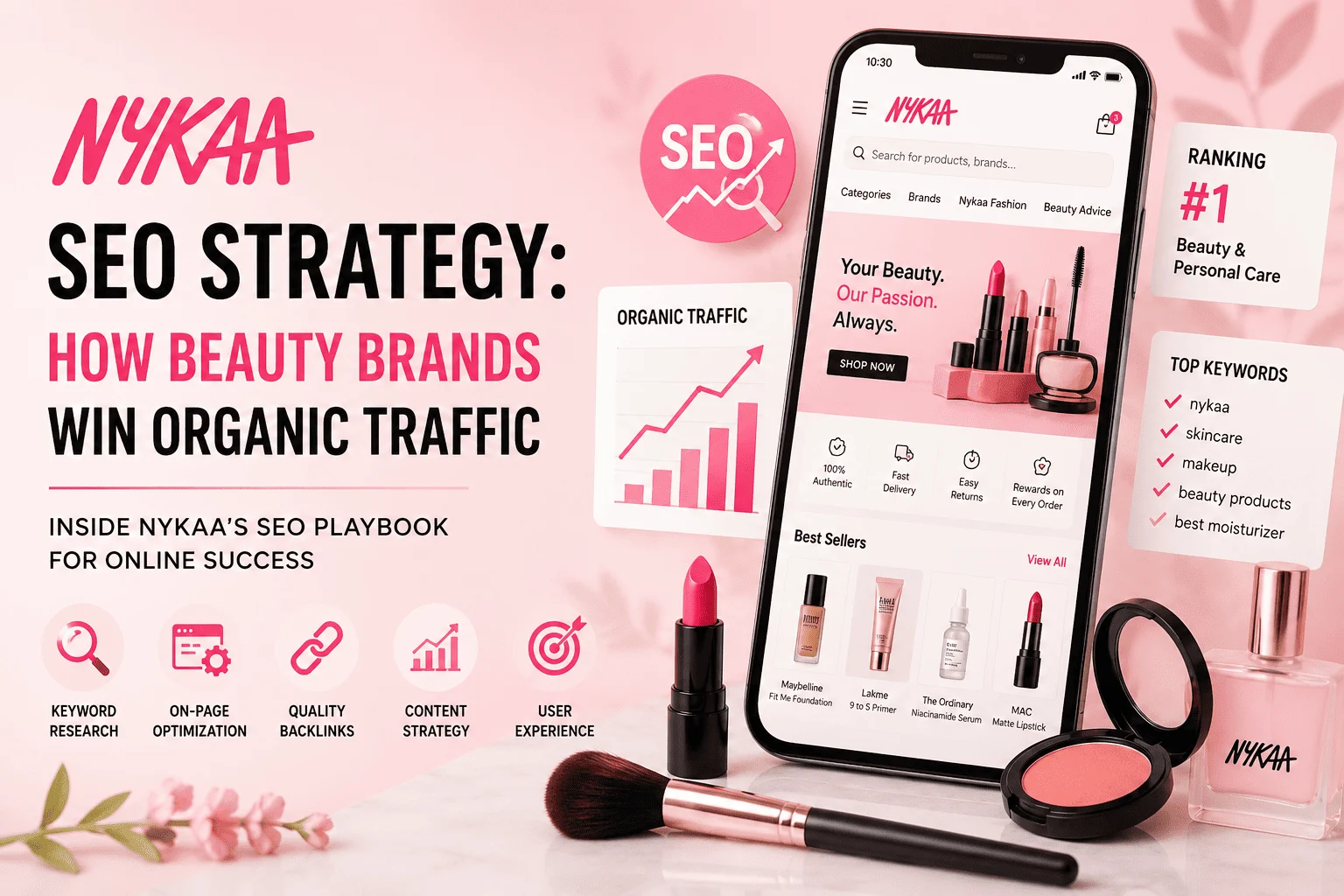
Nykaa’s SEO strategy is powerful because it does not depend only on product pages. It uses category pages, brand pages, product detail pages, filters, customer reviews, buying guides, ingredient-based content, app engagement, social media, influencer content, and seasonal campaigns to capture users at every stage of the buying journey.
Nykaa is one of the strongest examples of how a beauty and lifestyle brand can use SEO, content, product discovery, influencer-led demand, reviews, tutorials, category pages, and brand trust to build a powerful digital presence.
Beauty search is not simple. A customer does not always search for one product and buy immediately. They search for skin concerns, makeup looks, ingredients, shades, routines, brands, offers, reviews, and comparisons. Someone may search for “best vitamin C serum,” “foundation for oily skin,” “sunscreen for Indian skin,” “lipstick shade for dusky skin,” “hair serum for frizzy hair,” or “Nykaa pink sale offers.” These searches show different levels of intent, and Nykaa has built a digital ecosystem around them.
For beauty brands, skincare companies, makeup brands, wellness stores, personal care businesses, D2C brands, salons, and eCommerce companies, Nykaa’s strategy is worth studying. The biggest lesson is simple: in beauty SEO, trust and discovery are just as important as rankings.
This blog breaks down the SEO strategy of Nykaa, how it wins organic traffic, and what businesses can steal from its growth model.
About Nykaa
Nykaa is an Indian beauty, fashion, and lifestyle platform known for selling cosmetics, skincare, haircare, personal care, wellness products, fragrances, fashion products, and accessories. Its success is driven by a strong eCommerce SEO strategy that helps the brand rank for thousands of product and category keywords, attracting millions of organic visitors. Nykaa operates through its online platform, mobile app, private-label brands, brand partnerships, and offline retail stores, creating a seamless omnichannel shopping experience.
From an SEO perspective, Nykaa is interesting because beauty search is highly layered. Users search by product type, skin concern, ingredient, brand, price range, occasion, gender, shade, routine, and trend. Nykaa benefits by organizing products in a way that matches this behavior.
A user may not search only for “face wash.” They may search for “face wash for oily skin,” “salicylic acid face wash,” “face wash for acne,” “best face wash under 500,” “face wash for men,” or “dermatologist recommended face wash.” Each of these searches represents a different intent.
Nykaa’s platform captures these intents through category pages, product pages, filters, reviews, guides, and educational content. This makes it a strong example for any eCommerce brand that wants to grow through search.
The lesson is not limited to beauty. Any brand with multiple products, categories, use cases, and customer concerns can learn from Nykaa.
Why Nykaa Wins in Search
Nykaa wins because it understands the beauty buyer’s journey. Beauty shoppers often need guidance before purchase. They want to know which product suits their skin type, which shade will match, which ingredient works, whether the brand is genuine, what other customers say, and whether the product is worth the price.
Nykaa answers these questions through product information, reviews, ratings, images, filters, brand pages, offers, and educational content. This makes the platform useful for both search engines and users.
Another reason Nykaa wins is product depth. The platform has a large product range across makeup, skincare, haircare, wellness, luxury beauty, personal care, and fashion. This gives it the ability to target thousands of keywords.
But product depth alone is not enough. Nykaa’s real strength is structure. It organizes products by category, concern, brand, ingredient, price, popularity, customer rating, and trend. This helps users find what they need faster.
For smaller brands, the lesson is clear. SEO is not only about writing blogs. Your category pages, product pages, filters, reviews, images, and navigation are also part of your SEO strategy.
Nykaa’s Keyword Strategy
Nykaa’s keyword strategy is built around beauty search behavior. Instead of targeting only basic product names, it captures different types of intent.
The first keyword group is product-based. These include face wash, moisturizer, sunscreen, lipstick, foundation, eyeliner, mascara, shampoo, conditioner, perfume, body lotion, and hair serum. These are direct product searches.
The second group is concern-based. Beauty customers often search according to problems. Examples include acne, pigmentation, dark spots, oily skin, dry skin, frizzy hair, dandruff, hair fall, dull skin, open pores, and uneven skin tone.
The third group is ingredient-based. Modern beauty buyers search for ingredients like vitamin C, retinol, niacinamide, hyaluronic acid, salicylic acid, glycolic acid, ceramides, peptides, tea tree, and sunscreen SPF.
The fourth group is audience-based. These include skincare for men, makeup for beginners, skincare for teenagers, anti-aging products for women, bridal makeup products, and haircare for curly hair.
The fifth group is brand-based. Users search for specific beauty brands, product lines, launches, and collaborations. Nykaa benefits from hosting many popular domestic and global brands.
The sixth group is offer-based. Searches around Nykaa sale, beauty offers, lipstick discount, skincare sale, and festive beauty deals show strong commercial intent.
The seventh group is comparison and recommendation keywords. These include best sunscreen for oily skin, best vitamin C serum in India, best foundation for dry skin, and top lipstick brands.
This keyword depth allows Nykaa to attract users from discovery to purchase.
What Beauty Brands Can Steal From Nykaa’s Keyword Strategy
Beauty brands should stop targeting only product names and start building keyword layers.
A skincare brand should not only target “face serum.” It should also target “vitamin C serum,” “serum for pigmentation,” “serum for glowing skin,” “serum for oily skin,” “serum for dark spots,” and “best serum under 1000.”
A haircare brand should not only target “shampoo.” It can target “anti-dandruff shampoo,” “shampoo for hair fall,” “shampoo for curly hair,” “sulfate-free shampoo,” and “shampoo for dry scalp.”
A makeup brand should not only target “lipstick.” It can target “matte lipstick,” “nude lipstick for Indian skin,” “long-lasting lipstick,” “bridal lipstick shades,” and “lipstick under 500.”
Nykaa’s Category Page Strategy
Nykaa’s category pages are one of its strongest SEO assets. A category page helps users browse products within a specific segment, such as skincare, makeup, haircare, bath and body, fragrances, wellness, or luxury beauty.
Category pages are powerful because they target broad commercial keywords. A user searching for “sunscreen” or “lipstick” may not know which exact product they want. They need options, filters, reviews, price comparisons, and product details.
A strong category page guides the user from broad interest to specific selection. It usually includes product listings, filters, sorting options, price ranges, brand choices, customer ratings, offers, and sometimes short category descriptions.
This is useful for SEO because search engines can understand the page topic clearly. It is also useful for users because they can compare products quickly.
Many smaller eCommerce websites make the mistake of treating category pages as simple product grids. That is not enough. A category page should educate, guide, and convert.
What Brands Can Steal From Nykaa’s Category Strategy
Every eCommerce brand should improve category pages.
A skincare category page should include a short explanation, product filters, skin type filters, ingredient filters, concern filters, price filters, product ratings, FAQs, and links to related guides.
A fashion category page should include size filters, color filters, occasion filters, fabric filters, price filters, and styling guidance.
A wellness category page should include product type, benefit, usage, ingredients, customer reviews, and safety information where relevant.
A service business can also use this model. Instead of product categories, it can create service category pages. For example, a digital marketing agency can create pages for SEO, PPC, content writing, social media, performance marketing, and local SEO.
The principle is the same: help users browse according to their needs.
Nykaa’s Product Page SEO Strategy
Nykaa’s product pages are built to support buying decisions. A good beauty product page needs more than a name and price. It should explain what the product does, who it is for, how to use it, what ingredients it contains, what benefits it offers, and what customers think about it.
Beauty products require trust because users apply them to their skin, hair, or body. They want to avoid wrong purchases, irritation, mismatch, or wasted money. Product pages must reduce this hesitation.
Nykaa product pages usually support decision-making through product images, descriptions, benefits, ingredients, usage instructions, ratings, reviews, offers, delivery details, and related products.
This is why product page SEO is so important. If a page is thin, users may leave to search for reviews elsewhere. If the page is detailed, users can make a decision on the same website.
What Brands Can Steal From Nykaa’s Product Page Strategy
A beauty product page should include:
Product name
Clear product images
Skin or hair concern
Suitable skin type
Key ingredients
Main benefits
How to use
Product size
Customer reviews
Ratings
FAQs
Delivery information
Return policy
Related products
The content should answer real buyer questions.
For example, a sunscreen page should explain SPF, PA rating, skin type suitability, texture, white cast, water resistance, ingredients, and usage frequency.
A lipstick page should explain finish, shade, skin tone suitability, transfer resistance, staying power, and occasion.
The more useful the product page, the better it can rank and convert.
Nykaa’s Filter Strategy
Filters are very important in beauty eCommerce. A user may want a moisturizer, but the right moisturizer depends on skin type, concern, budget, ingredient preference, brand, texture, and rating.
Nykaa’s filtering system helps users narrow choices. Filters may include product type, brand, price, discount, skin type, concern, ingredient, formulation, rating, and shade.
This improves user experience because beauty shoppers can feel overwhelmed by too many options. Filters make discovery easier.
From an SEO perspective, filters also reveal how users think. Even if every filtered URL should not be indexed, the filter categories show important keyword opportunities. If many users filter by “oily skin,” that suggests a need for a dedicated page or guide.
What Brands Can Steal From Nykaa’s Filter Strategy
Brands should make product discovery easier.
A skincare website should allow filtering by skin type, concern, ingredient, product type, price, and routine step.
A makeup website should allow filtering by shade, finish, skin tone, product type, brand, price, and occasion.
A haircare website should allow filtering by hair type, concern, ingredient, product format, and usage.
If the website is small, filters can be replaced with clear navigation and collection pages. For example, create pages for oily skin, dry skin, acne care, anti-aging, hair fall control, and bridal makeup.
The goal is to reduce confusion and help customers find the right product quickly.
Nykaa’s Review and Rating Strategy
Reviews are one of Nykaa’s strongest conversion assets. Beauty shoppers rely heavily on reviews because product experience can vary by skin type, hair type, shade, texture, and personal preference.
A review can answer questions that the brand description may not. Does the sunscreen leave a white cast? Is the lipstick drying? Does the serum feel sticky? Does the shampoo work for frizzy hair? Is the foundation shade accurate?
These details matter.
Ratings give a quick trust signal, while reviews provide deeper context. Reviews also add fresh user-generated content to product pages. Customers naturally use search-friendly language when describing their experience.
For beauty brands, reviews are not optional. They are part of the sales process.
What Brands Can Steal From Nykaa’s Review Strategy
Beauty brands should actively collect detailed reviews.
Instead of asking only “Did you like the product?” ask customers to mention skin type, hair type, shade, usage duration, texture, result, and recommendation.
For example:
Skin type: oily
Used for: 3 weeks
Result: reduced dullness
Texture: lightweight
Would recommend: yes
This kind of structured review is more useful for future buyers.
Brands should also display reviews on product pages, category pages, landing pages, and ads. Strong reviews can improve both SEO and paid campaign performance.
Nykaa’s Brand Page Strategy
Nykaa hosts many beauty brands and creates brand-specific pages. These pages help users browse all products from a brand in one place.
Brand pages are powerful because many beauty shoppers search by brand name. If a user trusts a brand, they may want to explore its full range. This approach is similar to the Amazon SEO Strategy, where dedicated brand pages improve product discovery and search visibility.
A strong brand page can include a brand story, product categories, bestsellers, new launches, offers, customer ratings, and related products.
For SEO, brand pages can rank for branded searches and support internal linking. For conversion, they help users discover more products from the same brand.
What Businesses Can Steal From Nykaa’s Brand Page Strategy
A multi-brand eCommerce store should create strong brand pages.
A D2C brand should create its own brand story page, but it should not stop there. It should also create collection pages for bestsellers, new launches, skincare routine, haircare routine, and concern-based products.
A marketplace should create pages for each seller or brand. A fashion store can create designer pages. A wellness store can create supplement brand pages. A salon marketplace can create stylist or clinic pages.
The lesson is that brand discovery should have its own structured path.
Nykaa’s Content Strategy
Nykaa’s content strategy supports beauty education and reflects the value of Content Marketing Services in driving organic traffic and customer engagement. Beauty customers often need help choosing products, building routines, understanding ingredients, comparing shades, and following trends.
Educational content can include skincare guides, makeup tutorials, ingredient explainers, routine builders, product recommendations, trend articles, and expert tips.
This content works because beauty buyers are often problem-aware but not product-aware. They know they have acne, pigmentation, dry skin, or hair fall, but they may not know which product to choose.
Content helps bridge that gap.
A blog on “how to build a skincare routine for oily skin” can lead users to cleansers, toners, serums, moisturizers, and sunscreens. A guide on “best lipstick shades for Indian skin tones” can lead users to product pages.
This is how content supports commerce.
What Brands Can Steal From Nykaa’s Content Strategy
Beauty brands should create educational content around real customer questions.
Examples include:
How to choose sunscreen for oily skin
Vitamin C vs niacinamide
Best skincare routine for beginners
How to choose foundation shade online
Haircare routine for frizzy hair
Retinol for beginners
Best makeup products for college students
How to layer skincare products
Every guide should link naturally to relevant products or categories.
The goal is not to write random beauty blogs. The goal is to create content that helps customers choose better.
Nykaa’s Ingredient-Based SEO Strategy
Ingredient-based searches have become very important in beauty. Customers are more aware of what they apply to their skin and hair. They search for ingredients before buying products.
Nykaa benefits by offering products and content around ingredients like vitamin C, retinol, niacinamide, hyaluronic acid, salicylic acid, glycolic acid, ceramides, peptides, and tea tree.
Ingredient-based SEO works because it connects education with product discovery. A user may first search “what does niacinamide do,” then search “best niacinamide serum,” and finally buy a product.
This journey can be captured through blogs, category pages, product pages, and FAQs.
What Brands Can Steal From Nykaa’s Ingredient Strategy
Beauty brands should create ingredient pages and guides.
A skincare brand can create pages for vitamin C products, retinol products, niacinamide products, salicylic acid products, and hyaluronic acid products.
Each page should explain what the ingredient does, who it is suitable for, how to use it, what to avoid mixing, and which products contain it.
This builds authority and helps users feel informed.
Ingredient content should be clear and responsible. Avoid exaggerated claims. Explain benefits, usage, and precautions in simple language.
Nykaa’s Routine-Based SEO Strategy
Beauty customers often buy routines, not isolated products. A skincare routine may include cleanser, toner, serum, moisturizer, and sunscreen. A haircare routine may include shampoo, conditioner, mask, serum, and oil.
Nykaa benefits by helping users discover products that fit into routines, similar to the HubSpot SEO Strategy, which focuses on educating users with comprehensive, topic-focused content that guides them through every stage of their journey.
Routine-based SEO is powerful because it increases average order value. A user who comes for one product may buy multiple products if they understand the full routine.
It also improves education. Beginners often need help knowing what to use first, how often to use it, and which products work together.
What Brands Can Steal From Nykaa’s Routine Strategy
Beauty brands should build routine pages.
Examples include:
Morning skincare routine
Night skincare routine
Acne care routine
Anti-aging skincare routine
Hair fall control routine
Curly hair routine
Bridal skincare routine
Makeup routine for beginners
Each routine page should explain steps, product order, usage frequency, and recommended products.
This helps users buy with confidence and creates strong internal links between products.
Nykaa’s Shade and Personalization Strategy
Makeup shopping online can be difficult because shade matching is personal. Foundation, concealer, lipstick, blush, and compact products depend on skin tone, undertone, occasion, and preference.
Nykaa’s product discovery experience supports this by using filters, images, shade options, reviews, and product descriptions.
Personalization is important in beauty because the same product may work differently for different users. A lipstick shade may look different on different skin tones. A foundation may oxidize. A moisturizer may feel heavy on oily skin but perfect for dry skin.
This is why beauty SEO should include personalization language.
What Brands Can Steal From Nykaa’s Personalization Strategy
Beauty brands should create content for different customer types.
Examples include:
Foundation for warm undertones
Lipstick shades for dusky skin
Sunscreen for oily skin
Moisturizer for dry skin
Shampoo for curly hair
Makeup for beginners
Skincare for teenagers
Anti-aging products for 30s
This makes customers feel understood.
Instead of saying one product is for everyone, explain exactly who it is best for.
Nykaa’s Visual SEO Strategy
Beauty is visual. Product photos, swatches, tutorials, before-after visuals, packaging shots, and application videos influence buying decisions.
Nykaa uses visuals across product pages, social media, app campaigns, and promotional content. In beauty, visuals are not decoration. They are proof.
A customer wants to see texture, shade, finish, packaging, size, and real application. A lipstick product page without swatches is weak. A foundation page without shade guidance creates confusion. A skincare product without texture images may leave users unsure.
Visual content also supports social discovery. Beauty trends often start on Instagram, YouTube, and short-form video platforms. These searches later turn into Google and marketplace searches.
What Brands Can Steal From Nykaa’s Visual Strategy
Beauty brands should invest in strong visual content.
They should create product images, texture shots, shade swatches, application videos, routine videos, user-generated content, influencer tutorials, and comparison visuals.
Images should be optimized with descriptive file names, compressed sizes, and useful alt text.
Videos can be used on product pages, blogs, social media, and ads.
The more confidently users can see the product, the more likely they are to buy.
Nykaa’s Social Media and Influencer Strategy
Nykaa benefits from strong social media and influencer-driven demand. Beauty is one of the most influencer-friendly industries because users want recommendations, tutorials, reviews, and real product demonstrations.
Influencers help create awareness and trust. A makeup artist showing a product application can influence buying decisions more than a plain product description. A skincare creator explaining ingredients can make a product easier to understand.
Social media also creates branded search. A user may see a product on Instagram and later search for it on Google or Nykaa.
This is where SEO and social media connect. Social media creates demand. SEO captures that demand.
What Brands Can Steal From Nykaa’s Influencer Strategy
Beauty brands should work with creators strategically.
Instead of only chasing celebrities, brands can work with micro-influencers, dermatology educators, makeup artists, salon professionals, skincare creators, and real customers.
The content should be useful, not only promotional.
Examples include:
How to use the product
Before-after experience
Shade comparison
Ingredient explanation
Routine demo
Common mistakes
Honest review
Occasion-based makeup look
Influencer content can also be reused on product pages, ads, email campaigns, and social proof sections.
Nykaa’s Offer and Sale Strategy
Nykaa is known for beauty sales, festive offers, discounts, bundles, and app-based promotions. Offers help attract deal-seeking customers and increase repeat purchases.
In beauty eCommerce, sales work because customers often buy multiple products together. A discount can push users to try a new brand, stock up on favorites, or add complementary products.
However, the strategy is not only discounting. Nykaa also uses offers to create events. Sale campaigns become moments that users remember and search for.
This creates seasonal search demand around sale names, festive offers, brand discounts, and product launches.
What Brands Can Steal From Nykaa’s Sale Strategy
Brands should create planned promotional calendars.
A beauty brand can create campaigns around festive skincare, summer sunscreen, winter moisturizers, bridal season, wedding makeup, monsoon haircare, and year-end beauty kits.
Instead of random discounts, create themed offers.
Examples include:
Summer skincare sale
Wedding glow kit
Festive makeup bundle
Hair repair week
Beginner skincare kit
Buy more, save more
First order beauty offer
The key is to connect offers with customer needs and seasons.
Nykaa’s Private Label Strategy
Nykaa has also built its own brand ecosystem through private labels and owned brands. This gives the platform more control over product positioning, margins, brand storytelling, and customer loyalty.
From an SEO perspective, owned brands can create more branded searches over time. Instead of only selling other brands, a marketplace can build demand for its own products.
Private labels also allow deeper content control. The brand can create product education, ingredient stories, tutorials, and campaign pages around its own products.
This is useful for any marketplace or eCommerce platform that wants to move from reseller to brand owner.
What Businesses Can Steal From Nykaa’s Private Label Strategy
Marketplaces and retailers can consider building their own product lines if they understand customer demand.
A beauty marketplace can create its own skincare or makeup range. A fashion marketplace can create in-house basics. A wellness store can create curated kits. A salon chain can create haircare products.
But private labels should be based on real market gaps. Do not create products only to copy competitors. Use search data, customer reviews, product gaps, and demand patterns to guide development.
SEO can reveal what customers want before you build the product.
Nykaa’s Omnichannel Strategy
Nykaa’s strategy is not limited to online shopping. It also uses offline stores, app engagement, brand experiences, and physical retail presence. This helps build trust in a category where users often want to test products, see shades, or experience brands physically.
Omnichannel beauty is powerful because online and offline behavior support each other. A customer may discover a product online and buy in-store. Another customer may test a product in-store and reorder online.
For SEO, offline presence can support local search. Store pages, Google Business Profiles, reviews, and local inventory information can help capture nearby searches.
What Brands Can Steal From Nykaa’s Omnichannel Strategy
Beauty brands with physical stores should create location pages.
Each store page should include address, map, opening hours, services, available brands, store photos, reviews, contact details, and nearby landmarks.
Salons, beauty clinics, wellness stores, and cosmetic retailers can use the same strategy.
A salon can create pages for hair spa in a locality, bridal makeup in a city, nail art near me, or skincare consultation near a landmark.
Online and offline should not be separate. They should support the same customer journey.
Nykaa’s Internal Linking Strategy
Nykaa’s website naturally connects categories, products, brands, offers, reviews, and related products. This helps users move from one product to another and from one category to another.
Internal linking is important because beauty shoppers often browse before buying. A user reading about sunscreen may also need moisturizer, cleanser, toner, or after-sun care. A user viewing lipstick may also explore lip liner, foundation, blush, or makeup remover.
Good internal linking increases product discovery and average order value.
It also helps search engines understand website structure.
What Brands Can Steal From Nykaa’s Internal Linking Strategy
Beauty brands should connect pages intentionally.
A blog about acne care should link to acne face wash, salicylic acid serum, oil-free moisturizer, sunscreen for acne-prone skin, and an acne skincare routine.
A product page for vitamin C serum should link to moisturizer, sunscreen, pigmentation guide, and morning routine.
A category page for lipstick should link to lip liner, lip gloss, makeup remover, and shade guides.
This helps users discover the full solution, not just one product.
Nykaa’s Technical SEO Strategy
Large eCommerce websites need strong technical SEO. Nykaa has many products, categories, filters, brand pages, images, offers, and dynamic product variations. Without technical SEO, this can create duplicate pages, slow loading, indexation problems, and crawl waste.
For beauty eCommerce, technical SEO includes clean URLs, optimized images, mobile speed, product schema, review schema, canonical tags, proper category hierarchy, out-of-stock handling, and structured navigation.
Technical SEO also affects user experience. A beauty page with slow images or broken filters can lose users quickly.
A technically strong website helps both rankings and conversions.
What Brands Can Steal From Nykaa’s Technical SEO Strategy
eCommerce brands should take technical SEO seriously.
Focus on:
Fast page speed
Mobile-first design
Clean product URLs
Proper category structure
Optimized images
Schema markup
Canonical tags
Out-of-stock product handling
Broken link fixes
Secure checkout
Filter crawl control
Even a small Shopify, WooCommerce, or custom eCommerce website needs technical hygiene.
If the website is slow, confusing, or difficult to crawl, content and products will underperform.
Nykaa’s Full-Funnel Marketing Strategy
Nykaa’s SEO strategy works because it is supported by other channels. Social media creates trends. Influencers create awareness. Paid ads promote products and sales. Email and app notifications bring users back. Reviews build trust. Content educates users. Product pages convert buyers.
This is a full-funnel system.
A user may first discover a beauty trend on Instagram, then search for the product on Google, read reviews on Nykaa, compare shades, add it to cart, wait for a sale notification, and finally buy.
SEO plays a role, but it is not alone.
This is important for businesses because many brands expect SEO to do everything. In reality, beauty eCommerce growth needs SEO, social media, content, ads, email, influencer marketing, and retention working together.
What Brands Can Steal From Nykaa’s Full-Funnel Strategy
Beauty brands should create a connected marketing system.
SEO should bring long-term discovery.
Social media should create demand.
Influencers should build trust.
Paid ads should promote launches and offers.
Email should increase repeat purchases.
Reviews should improve conversion.
Product pages should close the sale.
When these channels work together, growth becomes more stable.
How a Beauty Brand Can Apply Nykaa’s SEO Strategy
A beauty brand can apply Nykaa’s strategy by building a complete content and commerce structure.
Start with strong product pages. Each page should include benefits, ingredients, skin type, how to use, reviews, FAQs, and related products.
Then build category pages for skincare, makeup, haircare, body care, and concern-based collections.
Next, create educational blogs around customer questions. For example, write about skincare routines, ingredients, product comparisons, seasonal care, and beginner guides.
Then add internal links between blogs, category pages, product pages, and routine pages.
Collect reviews and display them across the website.
Use social media and influencers to create awareness, then use SEO pages to capture demand.
This creates a growth system that works beyond paid ads.
How D2C Brands Can Apply Nykaa’s SEO Strategy
D2C brands can use Nykaa’s strategy even outside beauty. The same customer-first approach seen in the SEO Strategy for Hotels can be adapted to different industries by creating content that matches user intent and supports the buying journey.
A fashion brand can create category pages, size guides, occasion pages, styling blogs, reviews, and lookbooks.
A wellness brand can create ingredient guides, product pages, routine pages, health goal pages, and FAQs.
A home decor brand can create room-based pages, style guides, product collections, reviews, and visual inspiration.
The core principle is the same: organize the website around how customers search and how they decide.
D2C SEO is not just keyword placement. It is product education, trust, discovery, and conversion.
Common Mistakes Beauty Brands Should Avoid
The first mistake is creating thin product pages. Beauty customers need detailed information before buying.
The second mistake is not adding skin type, concern, ingredient, or usage information. These details affect both SEO and conversion.
The third mistake is using poor visuals. Beauty products need images, swatches, textures, and application examples.
The fourth mistake is ignoring reviews. Reviews are critical in beauty buying decisions.
The fifth mistake is writing generic blogs. Beauty content should answer specific customer concerns.
The sixth mistake is hiding FAQs. Product FAQs reduce hesitation.
The seventh mistake is not optimizing mobile experience. Beauty shoppers often browse on mobile.
The eighth mistake is depending only on marketplaces. Brands should also build their own website traffic and direct customer relationships.
Final Takeaway
Nykaa’s SEO strategy is powerful because it understands beauty buying behavior. Customers do not buy beauty products only by looking at price. They compare ingredients, skin type suitability, shades, reviews, tutorials, brand trust, offers, and product results.
Nykaa captures this journey through category pages, product pages, filters, brand pages, reviews, ingredient content, routine-based discovery, visual content, influencer demand, and full-funnel marketing.
The biggest lesson for beauty brands is that SEO should support the entire buying journey. A customer should be able to discover, learn, compare, trust, and buy without confusion.
Small brands can steal Nykaa’s strategy by creating better product pages, concern-based categories, ingredient guides, routine pages, searchable content, strong reviews, optimized visuals, and clear internal links.
You do not need Nykaa’s scale to apply Nykaa’s thinking. You need to understand your customer deeply and build your website around their real questions, concerns, and buying behavior.
FAQs
1. What is Nykaa’s SEO strategy?
Nykaa’s SEO strategy is based on product pages, category pages, brand pages, reviews, filters, ingredient-based content, routine-based discovery, visual content, and full-funnel beauty marketing. It captures users from research to purchase.
2. Why does Nykaa rank well for beauty searches?
Nykaa ranks well because it has deep product coverage, strong category structure, customer reviews, brand pages, educational content, and search-friendly product details. Its website matches how beauty customers search and shop.
3. What can beauty brands learn from Nykaa’s SEO strategy?
Beauty brands can learn to improve product pages, create concern-based categories, add ingredient guides, collect reviews, use high-quality visuals, build routine pages, and connect content with commerce.
4. Why are reviews important in beauty SEO?
Reviews are important because beauty products work differently for different skin types, hair types, and preferences. Reviews help customers understand real product experience and reduce purchase hesitation.
5. What type of keywords should beauty brands target?
Beauty brands should target product keywords, concern keywords, ingredient keywords, routine keywords, skin type keywords, shade keywords, brand keywords, and comparison keywords.
6. How can a skincare brand steal Nykaa’s strategy?
A skincare brand can create detailed product pages, skin concern pages, ingredient guides, morning and night routine pages, customer reviews, FAQs, product videos, and internal links between related products.
7. Why are category pages important for beauty eCommerce?
Category pages help users browse and compare products by type, concern, ingredient, price, brand, and rating. They also target broad commercial keywords and improve website structure.
8. How does social media support Nykaa’s SEO strategy?
Social media creates demand through trends, influencers, tutorials, and product discovery. Users often see a product on social media and later search for it on Google or Nykaa, which supports branded and product search.
9. Why is ingredient-based content important for beauty SEO?
Ingredient-based content is important because customers actively search for ingredients like vitamin C, retinol, niacinamide, and salicylic acid before buying. This content helps educate users and guide them to products.
10. What is the biggest SEO lesson from Nykaa?
The biggest lesson from Nykaa is that beauty SEO must combine education, trust, visuals, product discovery, reviews, and conversion. Ranking alone is not enough if the customer does not feel confident to buy.