
SEO Strategy for Hotels: Complete Growth Plan to Rank Higher and Increase Direct Bookings
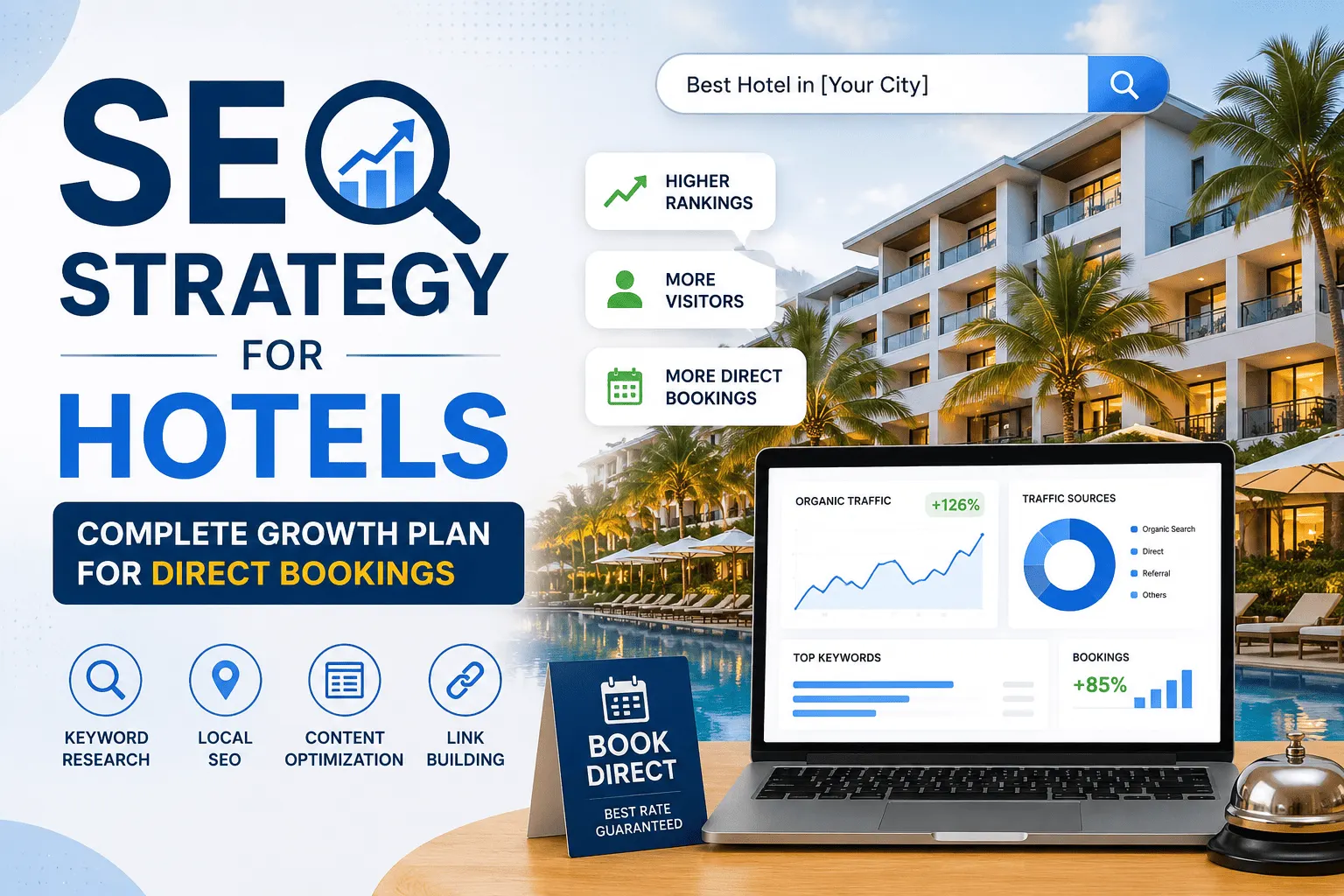
A strong SEO strategy for hotels helps your property rank for high-intent searches like “hotel in [city],” “best hotel near [landmark],” “luxury hotel in [location],” “family hotel near [area],” “business hotel in [city],” or “hotel with pool near me.” These searches often come from travelers who are already planning a stay and are close to booking.
Hotels operate in one of the most competitive search markets. Travelers compare locations, prices, amenities, reviews, photos, room types, nearby attractions, cancellation policies, and booking platforms before making a reservation. If your hotel does not appear when people search on Google, OTAs and competitors capture the booking first.
For hotels, SEO is not only about traffic. It is about direct bookings, brand trust, location visibility, local authority, and reducing dependency on third-party booking platforms. OTAs are important for distribution, but direct bookings give hotels better margins, stronger guest relationships, and more control over the customer experience.
A complete hotel SEO strategy includes keyword research, local SEO, Google Business Profile optimization, room page SEO, location page content, destination guides, technical SEO, image optimization, review management, backlinks, conversion optimization, and performance tracking. When these elements work together, SEO can become a long-term booking engine for the hotel.
Why SEO Matters for Hotels
SEO matters for hotels because travelers search online before booking. Whether they are planning a vacation, business trip, wedding stay, family holiday, weekend getaway, or corporate visit, Google is usually part of their decision-making process.
A traveler may start with broad searches like “best hotels in Dubai” or “hotels near Times Square.” Then they may compare options based on price, amenities, location, reviews, and photos. Finally, they may search for a specific hotel name before booking. A strong SEO presence helps your hotel appear across all these stages.
Hotel SEO helps with:
- More direct bookings
- Higher visibility for location-based searches
- Better ranking for room and amenity keywords
- Reduced dependency on OTAs
- More traffic from destination searches
- Stronger brand trust
- Better visibility in Google Maps
- More inquiries for events and group bookings
- Increased revenue from organic search
- Better long-term marketing ROI
Paid ads can generate bookings quickly, but hotels often compete with OTAs, travel platforms, and large chains. SEO builds long-term visibility and helps your hotel capture guests organically.
For independent hotels, boutique stays, resorts, serviced apartments, villas, and small hotel groups, SEO can be especially powerful because it allows them to compete with larger brands in specific local and niche searches.
Understanding How Hotel Guests Search Online
Before building an SEO strategy, hotels need to understand how guests search. Hotel searches are highly intent-driven, but intent changes based on trip type, budget, location, and traveler profile.
A guest may search:
- Hotels in [city]
- Best hotels near [landmark]
- Boutique hotel in [location]
- Family hotel in [city]
- Business hotel near the airport
- Hotel with free breakfast
- Resort with private pool
- Pet-friendly hotel near me
- Luxury hotel in [destination]
- Hotel near the convention center
- Wedding hotel venue in [city]
- Weekend getaway near [city]
These searches show different types of demand. Some guests search by location. Some search by amenities. Some search by experience. Some search by travel purpose. A hotel SEO strategy should cover all these patterns.
Location-Based Searches
These are the most common hotel searches. Travelers search for hotels in a city, neighborhood, near an airport, near a landmark, or close to an event venue.
Examples:
- Hotel in London
- Hotel near Dubai Mall
- Hotels near JFK Airport
- Hotel near Jaipur Railway Station
- Beach resort in Goa
Location-based searches should be targeted through homepage content, local landing pages, and destination-focused content.
Amenity-Based Searches
Many guests search based on the facilities they want.
Examples:
- Hotel with a swimming pool
- Hotel with free parking
- Hotel with airport shuttle
- Hotel with a conference room
- Hotel with spa
- Hotel with breakfast included
- Pet-friendly hotel
Amenity keywords can be included on service pages, room pages, FAQ sections, and supporting content.
Traveler-Type Searches
Different guests have different needs.
Examples:
- Family hotel in [city]
- Business hotel in [location]
- Romantic hotel for couples
- Budget hotel near [area]
- Luxury hotel for honeymoon
- Hotel for corporate travelers
These searches can be targeted through dedicated landing pages or well-structured website sections.
Event and Group Searches
Hotels can also target event-based searches.
Examples:
- Wedding hotel in [city]
- Hotel with a banquet hall
- Conference hotel near [location]
- Group booking a hotel
- Corporate stay hotel
- Hotel for destination wedding
These keywords are useful for hotels with event spaces, meeting rooms, banquet halls, or group booking capacity.
Keyword Research Strategy for Hotels
Keyword research for hotels should focus on location, property type, traveler intent, amenities, nearby landmarks, room types, and booking intent. The goal is not just to rank for “hotel in [city]” but to capture multiple search paths that lead to bookings. Similar to an Amazon SEO Strategy, where products are optimized for high-intent searches, hotel websites should target keywords that match travelers’ booking intent at every stage of their journey.
Primary Hotel Keywords
These are broad keywords that define your hotel and location.
Examples:
- Hotel in [city]
- Best hotel in [city]
- Hotel near me
- Resort in [location]
- Boutique hotel in [city]
- Luxury hotel in [location]
- Budget hotel in [city]
- Serviced apartment in [location]
These keywords are usually competitive, but they are important for homepage and main landing page optimization.
Landmark and Nearby Location Keywords
Hotels can generate strong leads by targeting nearby landmarks, airports, business districts, beaches, universities, hospitals, convention centers, and tourist attractions.
Examples:
- Hotel near [landmark]
- Hotel near [airport]
- Hotel near [hospital]
- Hotel near [university]
- Hotel near [convention center]
- Hotel near [business district]
- Hotel near [beach]
These keywords are valuable because travelers often choose accommodation based on convenience.
Room Type Keywords
Room pages can target specific room-related searches.
Examples:
- Deluxe room in [city]
- Suite hotel in [location]
- Family room hotel
- Hotel with a balcony room
- Ocean view room
- Hotel with private pool villa
- Serviced apartment with a kitchen
Room pages should not be thin. Each room page should include room features, amenities, photos, occupancy, size, view, inclusions, and booking information.
Amenity Keywords
Amenity keywords help attract guests with specific preferences.
Examples:
- Hotel with pool in [city]
- Hotel with spa in [location]
- Hotel with free breakfast
- Hotel with parking near [area]
- Hotel with a gym
- Hotel with airport transfer
- Hotel with restaurant
These keywords can support homepage content, amenity sections, blogs, and FAQs.
Experience-Based Keywords
Some travelers search based on the type of stay they want.
Examples:
- Romantic hotel in [city]
- Family-friendly resort
- Business hotel in [location]
- Honeymoon resort
- Weekend getaway hotel
- Luxury stay near [area]
- Heritage hotel in [city]
Experience-based pages can be powerful for hotels that offer a specific stay style.
Ideal Website Structure for Hotel SEO
A hotel website should be designed for both search visibility and direct bookings. It should help users understand the property, compare rooms, check amenities, explore the location, and book easily.
A strong hotel website structure may include:
| Page Type | Purpose | SEO Role |
| Homepage | Introduces the hotel and main value | Targets brand and core location keywords |
| Rooms Page | Shows all room options | Targets room and booking intent keywords |
| Individual Room Pages | Explains each room type | Captures long-tail room searches |
| Amenities Page | Lists hotel facilities | Targets amenity-based searches |
| Location Page | Explains nearby attractions and access | Supports local SEO |
| Dining Page | Promotes a restaurant or bar | Targets dining-related searches |
| Events Page | Promotes weddings, meetings, and groups | Targets event booking keywords |
| Offers Page | Promotes packages and deals | Supports booking conversion |
| Blog Section | Provides destination content | Builds topical authority |
| Gallery Page | Builds visual trust | Supports guest decision-making |
| Contact Page | Helps inquiries and directions | Supports local conversion |
Each page should have a clear SEO purpose. A hotel website should not rely only on the homepage to rank for everything. Room types, amenities, events, and nearby attractions deserve their own optimized sections.
Hotel Homepage SEO Strategy
The homepage is one of the most important pages on a hotel website. It should clearly explain the hotel’s location, experience, room options, amenities, and booking value.
A strong hotel homepage should include:
- Clear hotel positioning
- Main location keyword
- Short description of the property
- Room highlights
- Key amenities
- Nearby attractions
- Reviews or ratings
- Direct booking benefits
- Gallery preview
- Internal links to rooms and amenities
- Strong booking pathThe
- FAQ section is suitable
For example, instead of a generic heading like “Welcome to Our Hotel,” a stronger SEO-friendly heading could be “Boutique Hotel in Downtown [City] for Business and Leisure Travelers.”
The homepage should balance brand appeal with search relevance. It should feel natural, not keyword-stuffed.
Room Page SEO Strategy
Room pages are often underused in hotel SEO. Many hotels list room names but do not provide enough useful content. A well-optimized room page can rank for specific room searches and improve direct bookings.
A room page should include:
- Room name
- Room size
- Occupancy
- Bed type
- View
- Amenities
- Photos
- Inclusions
- Upgrade options
- Cancellation information
- Nearby relevant facilities
- FAQs
- Booking button
Example room page title:
Deluxe King Room in [City] with City View
Room descriptions should be unique. Avoid using the same description for every room with small changes. Each room should feel distinct and helpful.
Local SEO Strategy for Hotels
Local SEO is critical for hotels because travelers often search by destination, nearby landmarks, and map results. Google Maps visibility can directly influence bookings, calls, and direction requests.
A strong local SEO strategy includes Google Business Profile optimization, reviews, local citations, location content, and map ranking improvements. Similar to our Zomato SEO Strategy, hotels can improve their local search visibility by optimizing business listings, earning authentic customer reviews, and creating location-focused content that helps them rank higher in Google Maps and local search results.
Google Business Profile Optimization
Your Google Business Profile is one of the most important local SEO assets for a hotel. It can appear when travelers search for hotels near your location. As part of a complete SEO Checklist for Small Businesses, optimizing your Google Business Profile with accurate business information, high-quality photos, reviews, and regular updates can significantly improve your local search visibility and attract more direct bookings.
Important Google Business Profile elements:
- Correct hotel name
- Accurate address
- Local phone number
- Website booking link
- Business category
- Check-in and check-out times
- Hotel amenities
- Photos
- Room photos
- Guest reviews
- Questions and answers
- Regular updates
- Booking links where available
Hotels should keep photos updated. Travelers rely heavily on visuals, so room images, lobby photos, dining areas, pool images, exterior shots, and nearby views can influence booking decisions.
Reviews and Reputation
Reviews are extremely important for hotel SEO and booking conversion. Travelers compare ratings, review count, recent feedback, and management responses before booking.
Hotels should respond to reviews professionally. Positive reviews should be acknowledged, and negative reviews should be handled with care. A good response shows that the hotel listens and values guest experience.
Review signals can affect trust even before users visit the website. A hotel with strong reviews and updated responses has a better chance of attracting direct bookings.
Local Citations
Hotels should maintain consistent business information across travel directories, maps, business listings, and local platforms.
Important citation sources may include:
- Google Business Profile
- Bing Places
- Apple Maps
- Tripadvisor
- Yelp
- Local tourism websites
- Hotel directories
- Business directories
- Chamber of commerce websites
- Destination websites
Consistency matters. Hotel name, address, phone number, and website should match across all listings.
Destination Content Strategy for Hotels
Destination content is one of the most powerful SEO opportunities for hotels. Travelers search for things to do, places to visit, restaurants, events, transportation, local guides, and travel tips before and during their trip.
Hotels can attract these searches with helpful destination content. Similar to the Booking.com SEO Strategy, creating destination pages and local travel guides helps hotels capture travelers during the research stage and drive more direct bookings.
Best Blog Topics for Hotels
| Blog Topic | Search Intent |
| Best Things to Do in [City] | Trip planning |
| Best Restaurants Near [Hotel/Area] | Local research |
| Weekend Itinerary for [Destination] | Travel planning |
| Best Time to Visit [City] | Travel research |
| Family-Friendly Attractions in [City] | Family travel |
| Business Travel Guide to [City] | Corporate travel |
| How to Reach [Hotel Area] from [Airport] | Practical travel |
| Best Places to Visit Near [Landmark] | Local discovery |
| Wedding Venues in [City] | Event planning |
| Local Shopping Guide for [City] | Tourist research |
Destination blogs can internally link to room pages, offers, and location pages. This helps move travelers from research to booking.
Destination Content Clusters
A content cluster helps build authority around a location.
Example hotel destination cluster:
- Hotel in [City]
- Things to Do in [City]
- Best Restaurants Near [Area]
- Best Family Activities in [City]
- Business Travel Guide to [City]
- Best Weekend Itinerary in [City]
- Hotel Near [Landmark]
- How to Reach [Area] from [Airport]
These pages should link together naturally. The goal is to make the hotel website a useful resource for travelers, not just a booking page.
Technical SEO Strategy for Hotel Websites
Technical SEO ensures that your hotel website can be crawled, indexed, loaded quickly, and used easily. Hotel websites often have image-heavy pages, booking engines, scripts, galleries, and third-party integrations. These can affect performance if not optimized.
Important technical SEO elements include:
- Fast loading speed
- Mobile-friendly design
- Secure HTTPS
- Clean URL structure
- XML sitemap
- Robots.txt setup
- Proper indexing
- Canonical tags
- Broken link fixing
- Image compression
- Schema markup
- Core Web Vitals
- Booking engine compatibility
- Redirect management
- Multilingual SEO is needed
Mobile Optimization
Many hotel searches happen on mobile. Travelers may compare hotels while on the move, at the airport, in a cab, or during trip planning. A mobile-friendly website is essential.
Important mobile features include:
- Fast loading rooms
- Easy booking button
- Click-to-call phone number
- Simple navigation
- Easy gallery browsing
- Clear room rates
- Map integration
- Short booking flow
- Readable content
- Sticky booking option
If the booking process is difficult on mobile, users may leave and book through an OTA or competitor.
Image Optimization
Hotel websites depend on images, but large images can slow down the site. Image optimization is important for both SEO and booking conversion.
Image SEO includes:
- Compressed images
- Descriptive file names
- Alt text
- Proper image sizes
- Lazy loading
- High-quality visuals
- Room-specific image labels
Example file name:
deluxe-king-room-city-view.jpg
Example alt text:
Deluxe king room with city view at the hotel in [city]
Good images help guests trust the property and can also support visibility in image search.
Schema Markup for Hotels
Schema markup helps search engines understand hotel information. For hotel websites, structured data can support better interpretation of property details.
Useful schema types include:
- Hotel schema
- LocalBusiness schema
- LodgingBusiness schema
- FAQ schema
- Review schema
- Breadcrumb schema
- Organization schema
- Event schema where relevant
- Restaurant schema if the hotel has dining
A schema can include details like address, phone number, price range, amenities, rating, check-in time, check-out time, and location.
Link Building Strategy for Hotels
Backlinks help hotels build authority. For hotel SEO, relevant travel, local, lifestyle, event, and tourism links are especially useful.
Good backlink sources include:
- Local tourism websites
- Travel blogs
- Destination guides
- Event websites
- Wedding directories
- Local business directories
- Chamber of commerce websites
- Food and lifestyle blogs
- Local news websites
- Influencer travel features
- Partner attractions
- Conference websites
- University or hospital nearby pages where relevant
For example, a hotel near a wedding venue can collaborate with wedding planners and event directors. A business hotel can get listed on conference and corporate travel resources. A boutique hotel can earn links from travel bloggers and lifestyle publications.
Avoid spammy link-building packages. Hotel SEO should focus on trust, relevance, and local authority.
Conversion Strategy for Hotel SEO
SEO traffic should turn into bookings. A hotel website must make it easy for visitors to check availability, compare rooms, understand benefits, and complete the booking.
Important conversion elements include:
- Clear booking button
- Simple booking engine
- Best rate messaging
- Room comparison
- Guest reviews
- High-quality photos
- Direct booking benefits
- Clear cancellation policy
- Trust badges
- Location benefits
- Offers and packages
- Mobile-friendly booking
- Fast checkout
- Multiple payment options
- Live chat or inquiry option
Direct Booking Benefits
Hotels should clearly explain why guests should book directly.
Examples:
- Best available rate
- Flexible cancellation
- Room upgrade where available
- Free breakfast offer
- Early check-in option
- Late checkout option
- Exclusive packages
- Direct guest support
These benefits can help reduce OTA dependency and encourage users to book through the hotel website.
SEO KPIs Hotels Should Track
Hotel SEO should be measured through bookings, revenue, visibility, and engagement. Traffic alone is not enough.
Important hotel SEO KPIs include:
| KPI | Why It Matters |
| Organic Traffic | Shows search visibility growth |
| Keyword Rankings | Tracks SEO performance |
| Google Maps Visibility | Measures local presence |
| Direct Bookings | Shows revenue impact |
| Booking Engine Clicks | Tracks purchase intent |
| Room Page Visits | Shows interest in inventory |
| Conversion Rate | Measures booking efficiency |
| Revenue from Organic Search | Tracks business impact |
| Phone Calls | Measures direct inquiries |
| Direction Requests | Shows local demand |
| Review Growth | Builds trust |
| Backlink Growth | Measures authority |
Hotels should also track which pages assist bookings. Destination blogs, room pages, offer pages, and location pages may all contribute differently to revenue.
Common SEO Mistakes Hotels Should Avoid
Many hotel websites underperform because they rely too much on OTAs, have thin content, or ignore local search.
Relying Only on OTAs
OTAs can bring bookings, but hotels should also build direct visibility. SEO helps reduce dependency and improve margins.
Thin Room Pages
Room pages with only a photo and basic details may not rank well. Add unique descriptions, amenities, room size, occupancy, view, FAQs, and booking information.
Poor Mobile Booking Experience
If guests cannot book easily from mobile, they may leave. Hotel booking flows should be simple and fast.
Ignoring Local SEO
Hotels must optimize Google Business Profile, reviews, local citations, and nearby location content.
Using Generic Destination Content
Destination content should be useful and specific. Generic travel blogs that could apply to any city will not build strong authority.
Not Optimizing Images
Large images can slow down the website. Missing alt text and generic file names also reduce SEO quality.
Weak Direct Booking Messaging
If guests do not see a benefit in booking directly, they may return to OTAs. Hotels should clearly explain the direct booking value.
90-Day SEO Plan for Hotels
A hotel SEO campaign should begin with technical improvements, local SEO, page optimization, content planning, and conversion tracking.
Month 1: SEO Foundation
The first month should focus on research, audit, and setup.
Tasks:
- Full website audit
- Competitor analysis
- Keyword research
- Local SEO audit
- Google Business Profile audit
- Room page review
- Technical SEO fixes
- Tracking setup
- Booking flow review
- Content gap analysis
This stage helps identify which keywords, pages, and technical issues should be prioritized.
Month 2: Page Optimization and Local SEO
The second month should focus on improving important website pages and local visibility.
Tasks:
- Optimize homepage
- Improve room pages
- Optimize the amenities page
- Improve the location page
- Add internal links
- Add FAQs
- Optimize meta titles and descriptions
- Add schema markup
- Update Google Business Profile
- Improve image SEO
This helps the hotel website become more search-friendly and booking-focused.
Month 3: Content and Authority Growth
The third month should focus on destination content, backlinks, and conversion improvements.
Tasks:
- Publish destination blogs
- Create nearby landmark pages if needed
- Build local citations
- Start backlink outreach
- Improve review generation
- Add direct booking messages
- Track rankings and bookings
- Update underperforming pages
- Improve mobile booking experience
- Expand content clusters
By the end of 90 days, the hotel should have stronger local SEO, better optimized room pages, improved technical structure, and a clearer content strategy.
How Much Does SEO Cost for Hotels?
SEO for hotels usually costs between $1,000 and $10,000+ per month, depending on property size, location competition, website condition, content needs, technical complexity, number of rooms or locations, and booking goals. A small boutique hotel may need a focused local SEO and content plan, while a resort, hotel group, or competitive city hotel may need a larger campaign.
Several factors affect hotel SEO cost.
Location Competition
Hotels in competitive destinations need stronger SEO. Ranking in major cities, tourist hubs, airport areas, and luxury markets usually requires more content, authority, and optimization.
Website Condition
If the website is slow, outdated, poorly structured, or dependent on a weak booking engine, more work is needed.
Number of Pages
Hotels with multiple room types, restaurants, event spaces, offers, and locations need more page optimization.
Content Requirements
Hotel SEO may require room content, destination blogs, local guides, event pages, amenity pages, and FAQs.
Technical SEO Needs
Booking engines, image-heavy pages, scripts, multilingual pages, and tracking tools can increase technical SEO work.
Link Building Needs
Competitive hotel markets need high-quality backlinks from travel, local, tourism, lifestyle, and event websites.
Why Choose DM Thrive Agency for Hotel SEO?
Hotel SEO needs more than basic website optimization. It requires an understanding of travel search behavior, local visibility, direct booking strategy, destination content, review influence, and conversion optimization.
DM Thrive Agency helps hotels build SEO strategies focused on rankings, visibility, and direct booking growth. The goal is not only to bring more visitors but to attract travelers who are likely to book.
A hotel SEO campaign can include:
- Hotel keyword research
- Competitor analysis
- Website audit
- Local SEO
- Google Business Profile optimization
- Room page optimization
- Destination content writing
- Technical SEO
- Image SEO
- Link building
- Review strategy
- Conversion optimization
- SEO reporting
For hotels that want faster booking growth, SEO can work alongside PPC, paid ads, performance marketing, social media, and content campaigns. Paid campaigns can support immediate demand, while SEO builds long-term organic visibility and direct booking value.
FAQs About SEO Strategy for Hotels
How long does hotel SEO take to show results?
Hotel SEO usually starts showing early improvements within 3 to 6 months, depending on competition, website condition, local SEO strength, content quality, and backlink profile. Competitive hotel markets may take longer to generate a strong booking impact.
Is SEO important for hotels?
Yes, SEO is very important for hotels because travelers search online before booking. A strong SEO strategy helps hotels rank for location, room, amenity, landmark, and destination-related searches.
Can SEO increase direct bookings for hotels?
Yes, SEO can increase direct bookings by improving hotel website visibility, attracting high-intent travelers, optimizing room pages, and reducing dependency on OTAs.
What are the best keywords for hotel SEO?
The best hotel SEO keywords include location keywords, landmark keywords, room type keywords, amenity keywords, experience-based keywords, and event-related keywords. Examples include “hotel in [city],” “hotel near [landmark],” and “hotel with pool in [location].”
Should hotels create destination blogs?
Yes, destination blogs are useful because travelers search for things to do, restaurants, itineraries, local attractions, and travel tips before booking. These blogs can attract travel planners and support direct booking pages.
How does Google Business Profile help hotel SEO?
Google Business Profile helps hotels appear in local search and map results. It can generate website visits, calls, direction requests, and booking actions. Updated photos, reviews, amenities, and business details improve trust.
Do hotel room pages need SEO?
Yes, room pages should be optimized because they help guests compare options and can rank for room-specific searches. Each room page should include unique descriptions, photos, amenities, occupancy, size, and FAQs.
How much does hotel SEO cost?
Hotel SEO usually costs between $1,000 and $10,000+ per month, depending on location competition, website condition, property size, content needs, technical SEO, and link-building requirements.
Is local SEO important for hotels?
Yes, local SEO is essential for hotels. Travelers often search by city, area, landmark, airport, event venue, or nearby attraction. Local SEO helps hotels appear for these searches.
What makes a hotel SEO strategy successful?
A successful hotel SEO strategy includes keyword research, local SEO, Google Business Profile optimization, room page SEO, destination content, technical SEO, image optimization, reviews, backlinks, and conversion optimization.
Final Thoughts
SEO for hotels works best when it is connected to the complete traveler journey. Guests search for destinations, locations, amenities, room types, nearby attractions, reviews, and booking options before making a decision. Your hotel website should appear during these searches with useful pages, strong visuals, clear information, and an easy booking experience.
A strong hotel SEO strategy combines local SEO, room page optimization, destination content, technical improvements, image SEO, review management, backlinks, and conversion optimization. When these elements work together, hotels can improve search visibility, attract better guests, and increase direct bookings.
The best hotel SEO campaigns are not built around shortcuts. They are built around local relevance, traveler intent, trust, helpful content, fast performance, and consistent optimization. With the right strategy, SEO can become one of the most reliable long-term growth channels for hotels.