
Amazon SEO Strategy: How Product Pages Rank and Convert
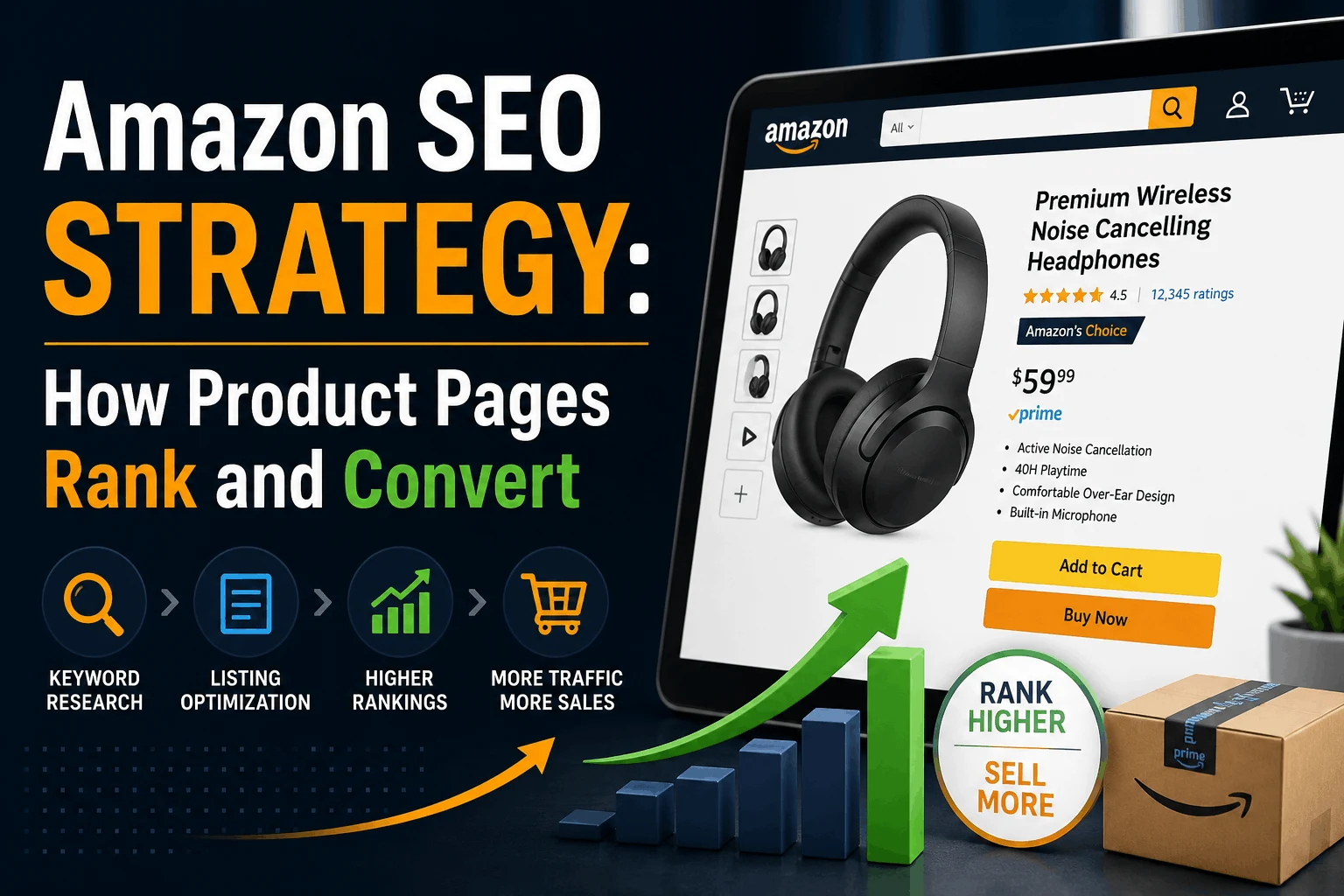
When people search for products online, they often start with Google or Amazon. In many cases, Amazon itself becomes the search destination. A user looking for headphones, office chairs, books, kitchen tools, skincare products, mobile accessories, home decor, or fitness equipment can search directly inside Amazon and compare hundreds of options within seconds.
This makes Amazon’s SEO strategy different from a normal website. It has two layers. The first layer is external SEO, where Amazon pages rank on Google for product, category, and buying-intent keywords. The second layer is internal marketplace SEO, where sellers compete to rank inside Amazon search results.
For eCommerce brands, D2C companies, marketplace sellers, local retailers, and even service businesses, Amazon’s strategy is worth studying. The biggest lesson is simple: SEO should not only bring traffic. It should help users find, compare, trust, and buy.
This blog breaks down the SEO strategy of Amazon, how its product pages and category pages dominate search, and what businesses can steal from its model.
About Amazon
Amazon started as an online bookstore and later expanded into a massive digital marketplace with products across almost every major consumer category. Today, users associate Amazon with choice, speed, reviews, convenience, and easy buying.
From an SEO perspective, Amazon’s biggest strength is its structure. It has millions of product pages, category pages, brand stores, seller pages, review sections, buying guides, and search result pages. But the real power is not only the number of pages. The real power is in how those pages are organized.
A customer searching for a product usually has a clear intent. They may want to compare prices, check reviews, see delivery timelines, understand features, or find the best option in a category. Amazon builds its experience around these needs.
This is why Amazon pages often perform well. They are not thin pages with basic product descriptions. They include product titles, images, specifications, reviews, ratings, FAQs, comparison tables, delivery details, seller information, offers, and related products.
The website answers the customer’s buying questions before they leave the page.
Why Amazon Wins in Search
Amazon wins because it understands commercial intent better than most websites. A user searching for “best wireless mouse,” “running shoes for men,” “laptop stand,” or “air fryer for home” is not just reading casually. They are likely close to buying.
Amazon builds pages that match this buying intent. Product pages show details. Category pages show options. Filters help users narrow results. Reviews build trust. Pricing helps with comparison. Delivery information reduces hesitation.
This creates a complete purchase journey.
Another reason Amazon wins is trust. Users know the platform. They know they can compare products, read reviews, check ratings, and place orders easily. This trust improves click-through rate and conversion.
Search engines also value useful pages. A page that gives users product information, reviews, options, and comparison support is more useful than a page with only two lines of description.
For smaller businesses, this is the first lesson to steal: ranking is not enough. Your page should be useful enough to keep the visitor and strong enough to convert them.
Amazon’s Keyword Strategy

Amazon’s keyword strategy is built around product intent. Unlike informational websites that focus heavily on “what is” or “how to” keywords, Amazon focuses strongly on keywords people use when they are ready to compare or buy.
The first keyword group is product-based. These are direct searches like “Bluetooth headphones,” “office chair,” “water bottle,” “face serum,” “gaming keyboard,” or “cotton bedsheet.” These keywords are simple but powerful because the user knows what they want.
The second group is category-based. Examples include “men’s running shoes,” “home gym equipment,” “kitchen storage containers,” “baby care products,” and “wireless accessories.” These keywords help Amazon rank for broader shopping intent.
The third group is feature-based. Users often search by feature, such as “noise cancelling headphones,” “ergonomic office chair,” “waterproof smartwatch,” “non-stick frying pan,” or “organic face wash.” Feature-based keywords help customers narrow their choices.
The fourth group is audience-based. These include searches like “laptop for students,” “gift for mom,” “toys for 3-year-old,” “shoes for runners,” or “skincare for oily skin.” These keywords connect products with user needs.
The fifth group is comparison and the best keywords. Examples include “best air fryer,” “best laptop stand,” “top rated vacuum cleaner,” or “best budget headphones.” These are valuable because users are actively evaluating options.
The sixth group is brand and model keywords. Users may search for specific brand names, product lines, or model numbers. Amazon benefits because it hosts many branded products and comparison choices.
The key lesson is that Amazon captures every layer of buying intent.
What Businesses Can Steal From Amazon’s Keyword Strategy
Businesses should build keyword systems around how customers shop.
An eCommerce brand should not only target product names. It should target categories, features, use cases, audience needs, comparisons, and problem-solving keywords.
For example, a skincare brand should not only target “face serum.” It can target “vitamin C serum,” “face serum for oily skin,” “face serum for glowing skin,” “best serum for dark spots,” and “anti-aging serum for women.”
A furniture brand should not only target “office chair.” It can target “ergonomic office chair,” “office chair for back pain,” “work from home chair,” “mesh office chair,” and “budget office chair.”
A service business can also use this strategy. An SEO agency should not only target “SEO services.” It can target “local SEO services,” “SEO for eCommerce,” “SEO for hotels,” “SEO audit services,” “technical SEO agency,” and “SEO services for small businesses.”
The idea is to understand how the buyer thinks before they buy.
Amazon’s Product Page SEO Strategy
Amazon’s product pages are built to rank, inform, and convert. A strong product page usually includes a keyword-rich title, multiple images, bullet points, product description, specifications, reviews, ratings, delivery details, return information, seller details, and related product suggestions.
The title plays an important role. It usually includes the product name, brand, main features, size, color, quantity, or model. This helps users and search engines quickly understand the product.
Images are equally important. In e-commerce, users cannot touch or test the product. Images become the first layer of trust. Good images show the product from multiple angles and help users understand size, use, and quality.
Bullet points help users scan quickly. Many buyers do not read long descriptions first. They scan benefits, features, dimensions, material, compatibility, and included items.
Reviews and ratings reduce risk. A user may trust a product more if hundreds or thousands of buyers have shared their experience.
The product page is not just a listing. It is a complete sales page.
What Businesses Can Steal From Amazon’s Product Page Strategy
Every e-commerce brand should treat product pages like landing pages.
A product page should include:
- Clear product title
- Strong product images
- Short benefit-focused bullets
- Detailed product description
- Specifications
- Size or usage guide
- FAQs
- Reviews
- Delivery information
- Return policy
- Related products
- Clear CTA
The goal is to answer every major question on the page itself.
A common mistake is writing product pages only for search engines. Another mistake is writing only for users and ignoring keywords. The right approach is both. Use the language customers search for, but explain the product in a way that feels useful and natural.
Service businesses can also apply this. A service page should work like a product page. It should explain the service, benefits, process, pricing factors, deliverables, proof, FAQs, and next step.
Amazon’s Category Page Strategy
Amazon’s category pages are powerful because they help users browse at scale. A category page groups similar products and gives users filters, sorting options, price ranges, brands, ratings, and product cards.
Category pages often target broader keywords. For example, a product page may target a specific headphone model, while a category page can target “wireless headphones.” Both are important, but category pages usually capture higher-volume searches.
A good category page helps users move from broad intent to specific choice. Someone searching for “running shoes” may not know the exact product they want. They need options. They may filter by size, brand, price, color, rating, or purpose.
Amazon’s category structure makes this easy.
From an SEO perspective, category pages are essential because they help search engines understand topical organization. A website with clear categories and subcategories looks more structured and useful.
What Businesses Can Steal From Amazon’s Category Strategy
eCommerce brands should invest heavily in category pages.
A clothing store should create categories like men’s shirts, women’s dresses, cotton kurtas, wedding outfits, office wear, plus-size fashion, and summer collection.
A home decor brand can create categories like wall art, lamps, rugs, cushion covers, wooden furniture, and table decor.
A tech store can create categories like mobile accessories, laptop accessories, gaming accessories, smart home devices, and audio products.
Each category page should include a short SEO introduction, filters, product listings, internal links, FAQs, and buying guidance.
Do not treat category pages as empty product grids. Add useful content that helps users choose.
Amazon’s Internal Search Strategy
Amazon’s internal search is one of its biggest strengths. Users can search for almost any product and quickly get relevant options. The search bar is central to the shopping experience.
Internal search matters because not every user wants to browse categories. Many users know what they want and want to find it quickly.
Amazon’s search experience supports product discovery with autocomplete suggestions, spelling correction, filters, sorting, sponsored results, product cards, ratings, and price comparisons.
This creates a fast shopping journey. Users do not need to understand the website structure. They can search directly and move toward purchase.
For large websites, internal search is a conversion tool. For smaller websites, it can still be useful if the product range or content library is large.
What Businesses Can Steal From Amazon’s Internal Search Strategy
If your website has many products, services, blogs, or resources, internal search should work properly.
An eCommerce website should have a search bar that understands product names, categories, common spellings, and popular searches.
A SaaS knowledge base should help users find help articles quickly.
A large service website should make services, industries, case studies, and blogs easy to discover.
Even if your website is small, navigation should act like an internal search. Users should quickly find what they need without confusion.
The lesson is simple: make discovery easy.
Amazon’s Review and Rating Strategy
Reviews are one of Amazon’s strongest conversion assets. A buyer often checks ratings before reading the product description. A product with strong reviews feels safer than a product with no social proof.
Reviews also provide natural keyword-rich content. Customers describe how they use the product, what they liked, what problems they faced, and whether it met expectations. This language often matches real buyer concerns.
Ratings help users make quick decisions. A product with a high rating and many reviews stands out in search results and category pages.
Amazon also uses review volume as a trust signal. A product with thousands of reviews can feel more reliable than a new product with no feedback.
However, reviews work best when they are authentic, specific, and visible.
What Businesses Can Steal From Amazon’s Review Strategy
Every business should collect and display reviews.
An eCommerce brand should collect product reviews, photo reviews, video reviews, and size or fit feedback.
A service business should collect client testimonials, case studies, Google reviews, and result-based feedback.
A SaaS company should collect user reviews, G2-style testimonials, feature feedback, and success stories.
The key is to make reviews visible where decisions happen. Do not keep all testimonials on one separate page. Add them to product pages, service pages, location pages, and pricing pages.
Reviews should answer buyer doubts. If customers often ask about quality, delivery, support, or results, reviews should help reduce those concerns.
Amazon’s Image SEO and Visual Strategy
Product images are central to Amazon’s conversion strategy. Users often judge a product before reading details. A clear image can create confidence, while a poor image can reduce trust.
Amazon product pages usually show multiple visuals: main image, side angles, lifestyle photos, close-ups, packaging, size references, infographics, and sometimes videos.
This helps users understand the product better. In online shopping, the image replaces the physical experience.
Images can also support SEO. Proper image optimization helps pages load faster and can improve image search visibility. Image quality also affects user engagement, which can influence conversion.
For businesses, visuals should not be treated as decoration. They are part of the sales process.
What Businesses Can Steal From Amazon’s Image Strategy
eCommerce brands should use high-quality product images with a clear purpose.
Show the product clearly.
Show the product in use.
Show size and scale.
Show important features.
Show packaging if relevant.
Use infographics for benefits.
Add product videos where possible.
Service businesses can also use visuals. A marketing agency can show dashboards, case study screenshots, campaign examples, and process graphics. A real estate company can show property photos, floor plans, locality maps, and video walkthroughs. A clinic can show treatment rooms, doctor profiles, before-and-after visuals where appropriate, and process explainers.
Strong visuals improve trust and decision-making.
Amazon’s Technical SEO Strategy
Amazon has a massive technical SEO challenge because it manages millions of product pages, dynamic filters, seller listings, variants, reviews, pricing changes, and availability updates.
Technical SEO helps search engines crawl and understand important pages. It also helps avoid problems like duplicate content, broken links, slow-loading pages, thin pages, and poor mobile experience.
For e-commerce websites, technical SEO is especially important because product variants can create duplicate URLs. Filters can create too many crawlable pages. Out-of-stock products can create poor user experiences. Large images can slow down pages.
Amazon’s scale makes technical SEO complex, but the principle is simple: the website must be fast, organized, crawlable, and user-friendly.
What Businesses Can Steal From Amazon’s Technical SEO Strategy
Every e-commerce website should focus on technical health.
Important areas include:
Fast loading speed
Mobile-friendly design
Clean URL structure
Proper category hierarchy
Optimized images
Schema markup
Canonical tags
Product availability handling
Broken link fixes
Secure checkout
Indexation control
A small eCommerce store may not have Amazon-level complexity, but it still needs technical SEO. A slow Shopify store, messy WooCommerce setup, or duplicate product structure can hurt rankings and sales.
Technical SEO is not optional. It protects both visibility and revenue.
Amazon’s Internal Linking Strategy
Amazon uses internal linking to keep users moving across the website. Product pages link to related products, frequently bought together items, brand stores, category pages, comparison options, and recommended products.
This improves product discovery. A user who does not buy one product may buy another. Internal linking also helps search engines understand relationships between products and categories.
Internal linking is especially powerful for e-commerce because it can distribute authority across important pages. Popular products can support related products. Category pages can support product pages. Buying guides can support categories.
Many smaller websites fail here. They publish products and blogs, but do not connect them properly.
What Businesses Can Steal From Amazon’s Internal Linking Strategy
A business website should guide users from one page to the next.
An eCommerce product page should link to related products, parent categories, complementary products, buying guides, and FAQs.
A blog should link to relevant product or service pages.
A category page should link to subcategories, popular products, comparison guides, and related collections.
A service page should link to case studies, pricing details, FAQs, and related services.
Internal links should feel natural. The goal is not to stuff links everywhere. The goal is to help users continue their journey.
Amazon’s Conversion Strategy
Amazon’s conversion strategy is built around reducing friction. The platform makes it easy to compare, trust, and buy.
Several elements support this: product ratings, reviews, fast delivery information, return policies, clear pricing, offers, product images, one-click style purchase flow, cart reminders, and personalized recommendations.
Amazon understands that buyers leave when they are confused. So the product page answers questions quickly.
Is this product good?
Is the price fair?
Will it arrive on time?
Can I return it?
What do other buyers say?
Are there better options?
Is this the right size or model?
When a page answers these questions, conversion improves.
What Businesses Can Steal From Amazon’s Conversion Strategy
Every business should reduce buying friction.
For eCommerce, show price, shipping, returns, reviews, product details, and support options clearly.
For service businesses, explain pricing range, process, deliverables, timeline, results, and contact options.
For SaaS companies, show features, demo access, pricing plans, integrations, security, and customer proof.
For local businesses, make it easy to call, WhatsApp, book, visit, or submit an enquiry.
A page should never make the user work too hard to take action.
Amazon’s Personalization Strategy
Amazon uses personalization to show relevant products, recommendations, offers, and browsing suggestions. Users see items based on their searches, past purchases, viewed products, wishlists, and browsing behavior.
Personalization improves discovery. Instead of showing the same products to everyone, Amazon guides users toward products they are more likely to consider.
This increases engagement and repeat purchases.
Smaller businesses may not have advanced personalization systems, but they can still apply the idea through segmentation.
What Businesses Can Steal From Amazon’s Personalization Strategy
Businesses can create separate pages for different customer types.
A skincare brand can create pages for oily skin, dry skin, acne-prone skin, anti-aging, and sensitive skin.
A furniture brand can create pages for home office, small apartments, luxury interiors, rental homes, and commercial spaces.
A marketing agency can create pages for startups, e-commerce brands, real estate businesses, travel companies, healthcare businesses, and local businesses.
The user should feel that the page is made for their specific needs.
That is the simplest form of personalization.
Amazon’s Paid Ads and Organic Strategy
Amazon is not only an organic marketplace. It also has a strong advertising system. Sponsored Products, Sponsored Brands, display ads, and brand stores allow sellers to increase visibility.
This creates an important lesson: organic and paid visibility often work together.
A product may use ads to get early visibility, sales, and reviews. Over time, better sales and engagement can support organic marketplace performance. Paid ads can also help test keywords, product titles, pricing, and conversion.
For businesses outside Amazon, the same idea applies. SEO and paid ads should support each other.
SEO builds long-term visibility. Paid ads create immediate traffic. Retargeting brings users back. Social media creates demand. Email improves repeat sales.
The best growth systems combine channels.
What Businesses Can Steal From Amazon’s Paid Strategy
Businesses should use paid campaigns to support SEO, not replace it.
An eCommerce brand can run Google Shopping ads while building product SEO.
A local business can run search ads for immediate leads while building location pages.
A SaaS company can run paid campaigns for demos while publishing comparison and use-case content.
A service company can use retargeting to bring back visitors who read blogs but did not enquire.
The lesson is not to depend on one channel. Use paid marketing for speed and SEO for compounding growth.
Amazon’s Brand Store Strategy
Amazon Brand Stores allow brands to create a dedicated shopping experience inside Amazon. This is useful because it gives sellers more control over brand presentation, product collections, and storytelling.
A brand store can include product categories, best sellers, videos, banners, and brand messaging. This helps customers explore the brand instead of viewing only one product.
This is important because many e-commerce businesses focus only on individual product pages. But strong brands create a bigger shopping experience.
A customer may come for one product and discover the full catalog.
What Businesses Can Steal From Amazon’s Brand Store Strategy
Businesses should create a strong brand experience on their own website.
An eCommerce brand should have collection pages, story pages, best-seller pages, product bundles, customer reviews, and educational content.
A service business should have service pages, industry pages, case studies, team pages, process pages, and resource pages.
A SaaS company should have feature pages, use-case pages, integration pages, customer stories, and help content.
The goal is to make the website feel like a complete brand, not a random collection of pages.
Amazon’s Content Strategy
Amazon’s content strategy is product-led. It does not depend only on blog posts. Every product title, bullet point, image, review, FAQ, comparison module, and category page is part of the content ecosystem.
This is a powerful lesson. Content is not only articles. Content is every piece of information that helps a buyer decide.
Amazon also supports product discovery through buying guides, category descriptions, brand content, and customer questions. These content elements answer real buying concerns.
For eCommerce SEO, this is critical. A product page with thin content will struggle to rank and convert. A product page with useful content has a better chance of attracting and converting users.
What Businesses Can Steal From Amazon’s Content Strategy
Businesses should create content around the buying journey.
For eCommerce, this includes product pages, category pages, buying guides, comparison pages, gift guides, FAQs, reviews, and usage guides.
For services, this includes service pages, pricing guides, industry pages, case studies, process pages, FAQs, and educational blogs.
For SaaS, this includes feature pages, alternatives pages, integration pages, templates, onboarding guides, and customer stories.
The best content strategy answers what the user needs before, during, and after purchase.
Amazon’s SEO Moat
Amazon’s SEO moat is difficult to copy because it combines brand trust, product depth, reviews, sellers, logistics, ads, user behavior, and marketplace scale.
A new eCommerce website cannot easily copy Amazon’s review volume, category depth, seller ecosystem, or customer trust. This gives Amazon a long-term advantage.
However, smaller businesses can still build their own moat.
A brand can build original product content, strong reviews, expert guides, niche authority, community, repeat customers, email lists, and direct traffic.
The goal is not to beat Amazon at everything. The goal is to become highly trusted in a specific niche.
A small brand can win by being more focused, more expert, more personal, and more specialized.
What Small Businesses Can Directly Steal From Amazon
The first thing to steal is product page depth. Do not publish thin product pages. Add titles, benefits, specifications, images, reviews, FAQs, and buying guidance.
The second thing to steal is category structure. Make browsing simple and logical.
The third thing to steal is review visibility. Reviews should appear where buying decisions happen.
The fourth thing to steal is internal linking. Connect products, categories, guides, and related pages.
The fifth thing to steal is search intent. Target product, category, feature, audience, and comparison keywords.
The sixth thing to steal is conversion clarity. Show price, delivery, return policy, and next steps clearly.
The seventh thing to steal is personalization. Create pages for different audiences and use cases.
The eighth thing to steal is the paid and organic balance. Use ads for speed and SEO for long-term growth.
The ninth thing to steal is brand experience. Build more than product listings. Build a full shopping journey.
The tenth thing to steal is trust. Make users feel safe before they buy. Following this SEO Checklist for Small Businesses can help improve both search visibility and conversions.
How an eCommerce Brand Can Apply Amazon’s SEO Strategy
Let’s say you run a D2C skincare brand. Instead of creating only a homepage and product pages, you can build a full SEO system.
Create category pages for face wash, face serum, sunscreen, moisturizer, and night cream. Then create use-case pages for oily skin, dry skin, acne-prone skin, pigmentation, anti-aging, and sensitive skin.
On each product page, add strong titles, benefits, ingredients, usage instructions, skin type suitability, reviews, FAQs, delivery information, and return policy.
Then create blogs around skincare routines, ingredient guides, comparison posts, and product education.
This creates a stronger ecosystem than simply listing products.
How a Service Business Can Apply Amazon’s SEO Strategy
A service business can use Amazon’s approach by treating each service page like a product page.
For example, a digital marketing agency can create separate pages for SEO, PPC, content writing, social media marketing, local SEO, technical SEO, and performance marketing.
Each page should include what the service includes, who it is for, benefits, process, pricing factors, expected timeline, case studies, FAQs, and contact options.
Then blogs should support these pages with educational and comparison content.
This turns the website into a structured growth engine instead of a simple brochure.
Common Mistakes Businesses Should Avoid
The first mistake is creating thin product pages. A product page with only a title, image, and price is not enough.
The second mistake is ignoring category pages. Many businesses focus only on individual products, but category pages often target broader search demand.
The third mistake is hiding reviews. Reviews should be visible and easy to scan.
The fourth mistake is weak internal linking. Products, categories, blogs, and guides should support one another.
The fifth mistake is a poor mobile experience. Most buyers browse on mobile, so slow or confusing pages lose sales.
The sixth mistake is unclear pricing, shipping, or return information. Buyers hesitate when important details are missing.
The seventh mistake is depending only on paid ads. Ads can bring traffic, but SEO builds long-term value.
The eighth mistake is ignoring customer language. Product content should use the words customers actually search for and understand.
Final Takeaway
Amazon’s SEO strategy is powerful because it is built around buying intent. The platform does not simply attract visitors. It helps them search, compare, trust, and purchase.
Its biggest strengths include product page depth, category structure, reviews, internal linking, technical SEO, paid visibility, personalization, and conversion-focused design.
The most important lesson for businesses is that every page should have a job. A product page should sell. A category page should guide. A review section should build trust. A blog should support discovery. A comparison page should help users decide.
Small businesses do not need Amazon’s scale to apply Amazon’s thinking. They need better structure, better content, better proof, and better user experience.
If a business can make its website easier to search, easier to trust, and easier to buy from, it can steal the strongest parts of Amazon’s strategy and apply them at its own level.
FAQs
1. What is Amazon’s SEO strategy?
Amazon’s SEO strategy is based on product intent, category structure, product page optimization, reviews, ratings, internal linking, technical SEO, and conversion-focused user experience. It ranks well because its pages help users compare and buy products quickly.
2. Why do Amazon product pages rank well on Google?
Amazon product pages rank well because they usually include detailed product titles, descriptions, images, specifications, reviews, ratings, pricing, delivery details, and related products. These elements make the pages useful for buying-intent searches.
3. What can eCommerce brands learn from Amazon’s SEO strategy?
eCommerce brands can learn to improve product pages, build strong category pages, collect reviews, optimize images, add FAQs, use internal links, and make buying easier. The biggest lesson is to create pages that both rank and convert.
4. Is Amazon SEO different from Google SEO?
Yes. Google SEO focuses on ranking pages in Google search results, while Amazon SEO focuses on ranking products inside Amazon’s marketplace search. However, both depend on relevance, trust, content quality, user behavior, and conversion signals.
5. Why are reviews important in Amazon’s SEO strategy?
Reviews help users trust products and make purchase decisions. They also add fresh customer-generated content to product pages. Strong reviews can improve conversion and make products more appealing in search and category results.
6. How can small businesses steal Amazon’s strategy?
Small businesses can steal Amazon’s strategy by creating detailed product or service pages, organizing categories clearly, showing reviews, improving mobile experience, adding FAQs, linking related pages, and reducing buying friction.
7. What type of keywords does Amazon target?
Amazon targets product keywords, category keywords, feature-based keywords, audience-based keywords, comparison keywords, and brand-specific keywords. This helps it capture users at different stages of the buying journey.
8. Why are category pages important for eCommerce SEO?
Category pages target broader search intent and help users browse multiple products. They also help search engines understand website structure. Strong category pages can rank for high-volume commercial keywords.
9. Does Amazon depend only on organic SEO?
No. Amazon also uses paid advertising, sponsored products, brand stores, retargeting, email, app engagement, and personalized recommendations. Its growth comes from a connected digital ecosystem, not only organic search.
10. What is the biggest SEO lesson from Amazon?
The biggest lesson from Amazon is that SEO should be connected with conversion. A page should not only attract traffic. It should help users compare, trust, and take action.
Related Blogs