
SEO Checklist for Small Businesses: 25 Steps to Rank Higher
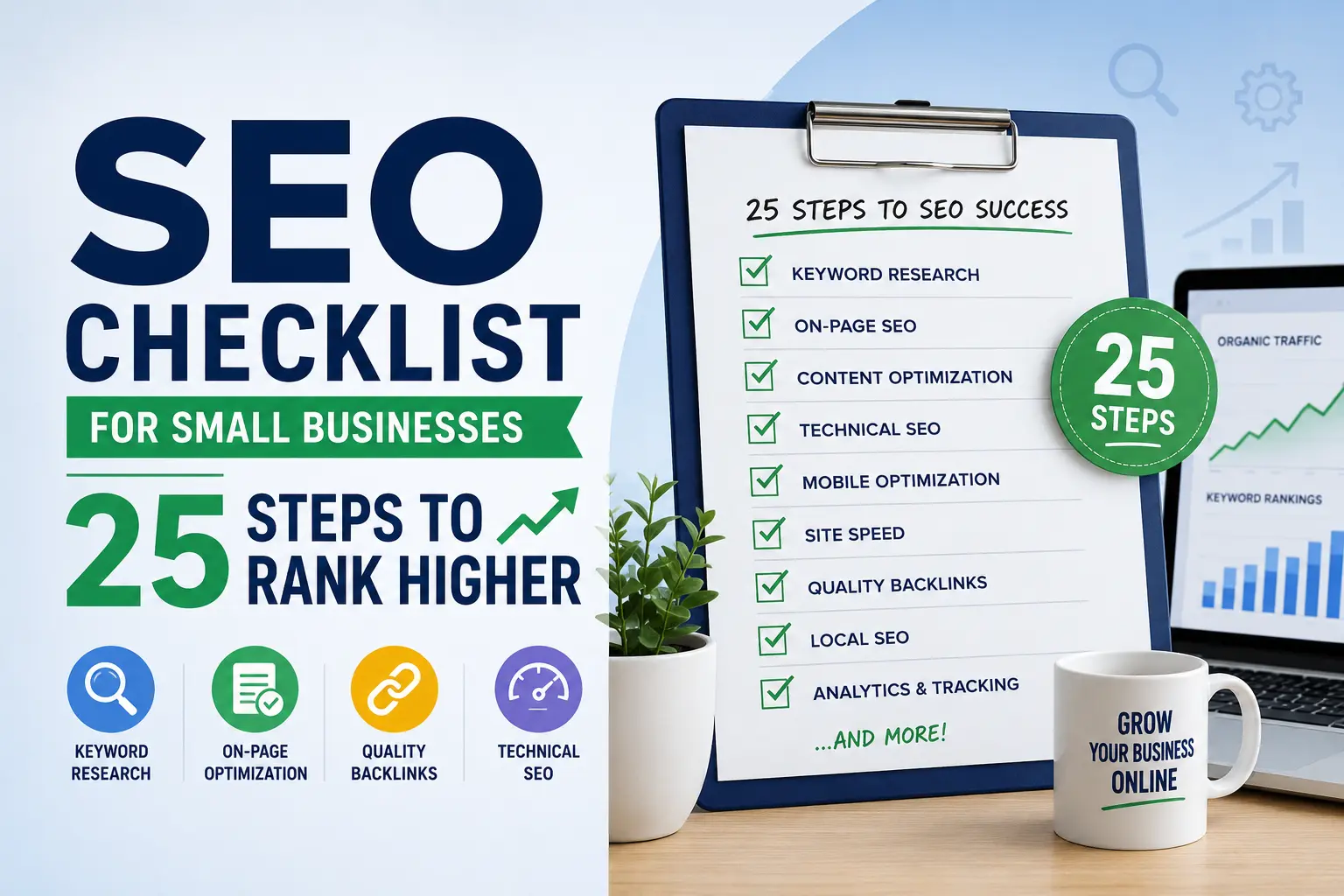
A well-executed SEO checklist for small businesses can help improve search rankings, increase website traffic, and generate more leads without relying entirely on paid advertising.
Many small business owners struggle with SEO because there are so many moving parts. From technical optimization and keyword research to content creation and local SEO, it can be difficult to know where to start.
The good news is that you don’t need a massive budget or a large marketing team to improve your search visibility. By following a structured SEO checklist, small businesses can build a strong foundation that helps attract customers through Google and other search engines.
In this guide, we’ll walk through a complete SEO checklist for local businesses covering technical SEO, on-page optimization, content marketing, local SEO, and link building so you can identify opportunities and improve your website’s performance.
Why SEO Matters for Small Businesses
SEO helps small businesses compete with larger brands by increasing their visibility in search results.
When potential customers search for products or services online, businesses that appear on the first page of Google receive the majority of clicks and traffic. Without SEO, even the best products or services can remain invisible to potential customers.
Unlike paid advertising, SEO continues to generate traffic over time. Once your website begins ranking for valuable keywords, it can attract visitors and leads without requiring a payment for every click.
Some of the biggest benefits of SEO for small businesses include:
- Increased website traffic
- More qualified leads
- Better local visibility
- Improved brand credibility
- Lower customer acquisition costs
- Long-term marketing results
SEO is not a one-time activity.
It requires ongoing optimization, content creation, and website improvements. That’s why using a structured checklist can help ensure that nothing important gets overlooked.
On-Page SEO Checklist
Once your technical foundation is in place, the next step is optimizing the content and structure of your website pages.
On-page SEO helps search engines understand what your pages are about and improves the chances of ranking for relevant keywords. It also enhances the user experience, which can positively impact engagement and conversions.
Perform Keyword Research
Keyword research is the starting point of every successful SEO strategy.
Focus on finding keywords that your potential customers actually search for.
Look for:
- Service-related keywords
- Local keywords
- Long-tail keywords
- Question-based keywords
- Low-competition opportunities
For example, instead of targeting a broad keyword like:
Accountant
Target:
Small business accountant in New York
Long-tail keywords are often easier to rank for and tend to generate more qualified leads.
Optimize Title Tags
The title tag is one of the most important on-page SEO elements.
It tells both users and search engines what the page is about.
Best practices include:
- Keep titles under 60 characters
- Include the target keyword
- Make titles compelling
- Avoid keyword stuffing
- Use unique titles for every page
Example:
Tax Services for Small Businesses in New York | ABC Accounting
Best SEO Services Cost in New York | ABC Accounting
Write Better Meta Descriptions
Meta descriptions do not directly impact rankings, but they can improve click-through rates.
A good meta description should:
- Summarize the page
- Include the target keyword
- Encourage users to click
- Stay under 160 characters
Think of it as an advertisement for your page in Google search results.
Use Proper Heading Structure
Headings help organize content and improve readability.
They also provide important context to search engines.
A proper structure looks like this:
- H1 for the page title
- H2 for major sections
- H3 for subsections
- H4 only when necessary
Avoid using multiple H1 tags on a single page.
Optimize Images
Images improve engagement, but they can also slow down your website if not optimized properly.
Image SEO checklist:
- Compress images before uploading
- Use descriptive file names
- Add keyword-rich alt text
- Use modern formats like WebP
- Resize images appropriately
Example:
Bad file name: image1.jpg
Good file name: small-business-seo-checklist.webp
Improve Internal Linking
Internal links help users navigate your website and help search engines discover important pages.
Link related content whenever possible.
Examples:
- Blog → Service page
- Service page → Contact page
- Blog → Related blog
- Location page → Service page
Strong internal linking improves crawlability and distributes SEO authority throughout your website.
Create SEO-Friendly URLs
URLs should be short, descriptive, and easy to understand.
Good URL examples:
- yoursite.com/seo-services
- yoursite.com/local-seo-guide
- yoursite.com/small-business-seo-checklist
Avoid URLs like:
- yoursite.com/page?id=123
- yoursite.com/blog-post-2025-final-version
On-Page SEO Quick Checklist

| Task | Status |
| Keyword Research Completed | □ |
| Unique Title Tags Added | □ |
| Meta Descriptions Optimized | □ |
| Proper H1-H2-H3 Structure | □ |
| Images Optimized | □ |
| Alt Text Added | □ |
| Internal Links Added | □ |
| SEO-Friendly URLs Used | □ |
| Keywords Added Naturally | □ |
| Pages Optimized for User Experience | □ |
A properly optimized page gives search engines the information they need to understand your content while making it easier for visitors to find what they’re looking for. This creates a strong foundation for higher rankings and better engagement.
Content SEO Checklist
Content is one of the most powerful SEO assets for small businesses.
A technically perfect website can still struggle to rank if it lacks useful, relevant, and optimized content. Search engines want to provide users with the best answers, which is why content plays such a significant role in rankings.
A strong content strategy helps you target more keywords, build authority, and attract qualified traffic.
Create Dedicated Service Pages
Many small businesses make the mistake of listing all their services on a single page.
Instead, create separate pages for each service you offer.
For example, an accounting firm might have:
- Bookkeeping Services
- Tax Filing Services
- Payroll Services
- CFO Services
- Accounting for Small Businesses
This allows each page to target specific keywords and search intent.
Publish Blog Content Regularly
Blogging remains one of the most effective ways to grow organic traffic.
Every blog creates another opportunity to rank for relevant keywords and answer customer questions.
Good blog topics include:
- Industry guides
- How-to articles
- Cost guides
- Comparison posts
- Frequently asked questions
- Local industry trends
Consistency matters more than volume.
Publishing two high-quality articles per month is often more effective than publishing ten low-quality posts.
Target Long-Tail Keywords
Long-tail keywords are more specific search queries that often have lower competition and higher conversion rates.
Examples:
| Broad Keyword | Long-Tail Keyword |
| SEO Services | SEO Services for Small Businesses |
| Accountant | Accountant for Startups in Chicago |
| Dentist | Emergency Dentist in Dallas |
| Bookkeeping | Outsourced Bookkeeping for Small Businesses |
Long-tail keywords are often easier to rank for and attract highly targeted visitors.
Update Existing Content
SEO is not only about creating new content.
Refreshing existing pages can often produce faster results.
Content updates may include:
- Adding new information
- Improving keyword targeting
- Updating statistics
- Expanding thin content
- Improving internal links
- Adding FAQs
Many businesses see ranking improvements simply by updating older content.
Add FAQs to Important Pages
FAQ sections help answer common customer questions while creating opportunities to rank for long-tail searches.
Good pages for FAQs include:
- Service pages
- Location pages
- Pricing pages
- Product pages
- Blog posts
Example questions:
- How much does this service cost?
- How long does it take?
- What is included?
- Who is this service for?
FAQs also improve user experience and can increase search visibility.
Optimize Content for Search Intent
Every piece of content should match what the user is looking for.
Different searches require different types of content.
| Search Intent | Content Type |
| Informational | Guides, tutorials, blogs |
| Commercial | Comparisons, reviews |
| Transactional | Service pages, landing pages |
| Navigational | Brand pages |
Matching content to intent improves rankings and conversion rates.
Content SEO Quick Checklist
| Task | Status |
| Dedicated Service Pages Created | □ |
| Blog Content Published Regularly | □ |
| Long-Tail Keywords Targeted | □ |
| Existing Content Updated | □ |
| FAQs Added | □ |
| Search Intent Optimized | □ |
| Internal Links Added | □ |
| Content Freshness Maintained | □ |
| Keyword Cannibalization Checked | □ |
| Content Optimized for Users | □ |
A strong content strategy helps small businesses build authority, target more keywords, and create sustainable organic traffic growth over time.
Local SEO Checklist
For many small businesses, local SEO is the fastest way to generate leads from Google.
If you serve a specific city, region, or local market, local SEO helps your business appear in Google Maps, local search results, and “near me” searches.
A well-optimized local presence can significantly increase phone calls, inquiries, bookings, and store visits.
Optimize Your Google Business Profile
Your Google Business Profile (formerly Google My Business) is one of the most important local SEO assets.
A fully optimized profile improves visibility in Google Maps and local search results.
Make sure your profile includes:
- Accurate business name
- Correct address
- Phone number
- Website URL
- Business hours
- Primary and secondary categories
- Business description
- High-quality photos
Complete profiles tend to perform better than incomplete listings.
Build Local Citations
Local citations are mentions of your business information across online directories.
These citations help Google verify your business details and improve local trust signals.
Popular citation sources include:
- Yelp
- Yellow Pages
- Bing Places
- Apple Maps
- Local business directories
- Industry-specific directories
The key is maintaining consistency across all listings.
Collect Customer Reviews
Reviews are one of the strongest local ranking factors.
Businesses with more positive reviews often receive greater visibility and higher click-through rates.
Encourage satisfied customers to leave reviews on:
- Yelp
- Industry review platforms
Best practices include:
- Request reviews after successful transactions
- Respond to every review
- Address negative feedback professionally
- Never purchase fake reviews
Create Location Pages
Businesses serving multiple cities should create dedicated location pages.
For example:
Each page should contain:
- Unique content
- Local keywords
- Service information
- Customer testimonials
- Contact information
Avoid duplicating the same content across multiple locations.
Maintain NAP Consistency
NAP stands for:
- Name
- Address
- Phone Number
Your NAP information should be identical across:
- Website
- Google Business Profile
- Directories
- Social media profiles
- Citation websites
Even small inconsistencies can create confusion for search engines and reduce local SEO effectiveness.
Add Local Business Schema
Schema markup helps search engines understand important business information.
Local Business Schema can provide details such as:
- Business name
- Address
- Phone number
- Operating hours
- Reviews
- Services
While schema alone won’t guarantee rankings, it helps search engines better interpret your business data.
Local SEO Quick Checklist
| Task | Status |
| Google Business Profile Optimized | □ |
| Business Categories Selected | □ |
| Photos Uploaded | □ |
| Local Citations Created | □ |
| Customer Reviews Collected | □ |
| Review Responses Managed | □ |
| Location Pages Created | □ |
| NAP Consistency Verified | □ |
| Local Keywords Targeted | □ |
| Local Business Schema Added | □ |
For most small businesses, local SEO can deliver some of the quickest and most measurable results because it targets customers who are actively searching for nearby products and services.
Off-Page SEO Checklist
Off-page SEO focuses on improving your website’s authority and credibility outside of your own website.
Search engines view backlinks, brand mentions, reviews, and online reputation as signals of trust. The stronger your authority profile, the easier it becomes to rank for competitive keywords.
For small businesses, off-page SEO should focus on quality rather than quantity.
Build Quality Backlinks
Backlinks remain one of Google’s most important ranking signals.
A backlink occurs when another website links to your website.
However, not all links are equal.
A single backlink from a respected industry website can be more valuable than dozens of low-quality links.
Focus on obtaining links from:
- Industry websites
- Local business websites
- News publications
- Resource pages
- Business associations
- Trusted blogs
Quality always outweighs quantity.
Guest Posting Opportunities
Guest posting allows you to publish content on other relevant websites while earning backlinks and increasing brand exposure.
Benefits include:
- Building authority
- Reaching new audiences
- Earning quality backlinks
- Increasing brand awareness
Look for websites that are relevant to your industry rather than pursuing backlinks from unrelated sites.
List Your Business in Trusted Directories
Business directories help strengthen local SEO and create valuable citations.
Examples include:
- Yelp
- Better Business Bureau
- Chamber of Commerce
- Industry-specific directories
- Local business associations
Focus on trusted directories that provide real value rather than submitting to hundreds of low-quality sites.
Earn Brand Mentions
A brand mention occurs when another website talks about your business, even if they don’t directly link to it.
Examples include:
- Industry interviews
- Expert roundups
- Podcasts
- Press mentions
- Local news coverage
These mentions help build credibility and may lead to future backlink opportunities.
Use Digital PR
Digital PR combines public relations with SEO.
The goal is to earn coverage from authoritative websites and media publications.
Examples include:
- Original research
- Industry reports
- Surveys
- Case studies
- Newsworthy announcements
Digital PR can generate high-quality backlinks while strengthening brand visibility.
Monitor Your Backlink Profile
Not all backlinks help your website.
Regularly review your backlink profile to identify:
- Toxic links
- Spam backlinks
- Lost backlinks
- New backlink opportunities
Monitoring backlinks helps maintain a healthy authority profile and protects your website from potential ranking issues.
Off-Page SEO Quick Checklist
| Task | Status |
| Quality Backlinks Acquired | □ |
| Guest Posting Opportunities Used | □ |
| Business Directories Submitted | □ |
| Brand Mentions Earned | □ |
| Digital PR Campaigns Conducted | □ |
| Backlink Profile Monitored | □ |
| Toxic Links Reviewed | □ |
| Industry Partnerships Built | □ |
| Local Authority Links Acquired | □ |
| Competitor Backlinks Analyzed | □ |
Strong off-page SEO helps search engines view your website as trustworthy and authoritative. Combined with technical SEO, on-page optimization, content marketing, and local SEO, it creates a complete strategy for long-term organic growth.
Common SEO Mistakes Small Businesses Should Avoid
Many small businesses invest time and money into SEO but fail to see results because of avoidable mistakes.
Even a few SEO errors can limit rankings, reduce traffic, and make it harder for search engines to understand your website.
Avoiding these common mistakes can save months of effort and improve the effectiveness of your SEO strategy.
Ignoring Keyword Research
One of the biggest SEO mistakes is creating content without understanding what customers are searching for.
Many businesses target keywords based on assumptions instead of data.
Without proper keyword research, you may:
- Target the wrong audience
- Create content nobody searches for
- Miss valuable ranking opportunities
- Struggle to generate qualified traffic
Always base content decisions on actual search demand.
Targeting Keywords That Are Too Competitive
Small businesses often try to rank for broad keywords immediately.
For example:
Instead of targeting:
Accountant
Target:
Small Business Accountant in Austin
Instead of:
SEO Services
Target:
SEO Services for Small Businesses
Long-tail keywords often provide faster wins and higher conversion rates.
Publishing Thin Content
Short pages with little value rarely perform well in search results.
Common examples include:
- 200-word service pages
- Duplicate location pages
- Generic blog posts
- Poor product descriptions
Every page should provide useful information that helps users solve a problem or answer a question.
Neglecting Technical SEO
Many business owners focus entirely on content while ignoring technical issues.
Common technical problems include:
- Slow website speed
- Broken links
- Indexing issues
- Mobile usability problems
- Duplicate content
- Missing schema markup
Technical issues can prevent otherwise strong content from ranking effectively.
Ignoring Local SEO
For local businesses, ignoring local SEO is one of the biggest missed opportunities.
Many businesses fail to:
- Optimize Google Business Profile
- Collect reviews
- Build local citations
- Create location pages
This can significantly reduce visibility in local searches and Google Maps.
Keyword Stuffing
Adding the same keyword repeatedly throughout a page does not improve rankings.
In fact, it can harm readability and create a poor user experience.
Instead of forcing keywords into every sentence, focus on:
- Natural language
- Related terms
- User intent
- Helpful content
Modern SEO is about relevance and quality, not keyword density.
Failing to Build Internal Links
Many websites publish content but never connect related pages together.
Poor internal linking can:
- Reduce crawlability
- Limit page authority distribution
- Make navigation difficult
- Reduce engagement
Every important page should link to relevant content within your website.
Not Tracking SEO Performance
You cannot improve what you do not measure.
Without tracking, businesses often have no idea:
- Which pages drive traffic
- Which keywords rank
- Which pages convert
- Which strategies work
At a minimum, every business should use:
These tools provide essential insights for improving SEO performance.
Expecting Immediate Results
SEO is a long-term marketing strategy.
Many businesses abandon SEO after a few weeks because they expect instant rankings.
In reality:
- Technical improvements take time
- Content takes time to rank
- Backlinks take time to influence authority
- Search engines need time to process changes
Most businesses begin seeing meaningful results within three to six months, with stronger growth occurring over time.
Small Business SEO Mistakes Checklist
| Mistake | Avoid It By |
| No Keyword Research | Use keyword tools and search intent analysis |
| Targeting Broad Keywords | Focus on long-tail opportunities |
| Thin Content | Create helpful, detailed content |
| Technical Issues | Conduct regular SEO audits |
| Ignoring Local SEO | Optimize Google Business Profile |
| Keyword Stuffing | Write naturally for users |
| Poor Internal Linking | Connect related pages |
| No Analytics | Track performance regularly |
| No Backlink Strategy | Build quality authority links |
| Expecting Quick Results | Commit to long-term SEO |
Avoiding these mistakes can often produce faster improvements than chasing advanced SEO tactics. A strong foundation, consistent optimization, and patience are usually the keys to long-term SEO success for small businesses.
Small Business SEO Checklist Table
If you’re short on time, use this quick checklist to review your SEO efforts. Completing these tasks regularly will help improve rankings, visibility, and lead generation.
| Category | Task | Priority |
| Technical SEO | Set up Google Search Console | High |
| Technical SEO | Set up Google Analytics | High |
| Technical SEO | Submit XML Sitemap | High |
| Technical SEO | Fix website speed issues | High |
| Technical SEO | Ensure mobile friendliness | High |
| Technical SEO | Enable HTTPS | High |
| On-Page SEO | Conduct keyword research | High |
| On-Page SEO | Optimize title tags | High |
| On-Page SEO | Write compelling meta descriptions | High |
| On-Page SEO | Use proper heading structure | High |
| On-Page SEO | Optimize images and alt text | Medium |
| On-Page SEO | Improve internal linking | High |
| Content SEO | Create dedicated service pages | High |
| Content SEO | Publish blogs consistently | High |
| Content SEO | Target long-tail keywords | High |
| Content SEO | Update old content regularly | Medium |
| Content SEO | Add FAQs to important pages | Medium |
| Local SEO | Optimize Google Business Profile | High |
| Local SEO | Build local citations | High |
| Local SEO | Collect customer reviews | High |
| Local SEO | Create location pages | Medium |
| Local SEO | Maintain NAP consistency | High |
| Off-Page SEO | Build quality backlinks | High |
| Off-Page SEO | Guest post on relevant websites | Medium |
| Off-Page SEO | Monitor backlink profile | Medium |
| Off-Page SEO | Earn brand mentions | Medium |
A small business that consistently completes these tasks will be in a much stronger position than competitors that only focus on occasional SEO activities.
Conclusion
A structured SEO checklist for small businesses helps turn SEO from a confusing process into a manageable growth strategy.
By focusing on technical SEO, on-page optimization, content creation, local SEO, and authority building, small businesses can improve their search visibility and attract more qualified customers from Google.
The most important thing to remember is that SEO is not a one-time project. Search algorithms, competitors, and customer behavior constantly change. Businesses that regularly review and improve their SEO efforts are more likely to achieve sustainable rankings and long-term traffic growth.
Start with the high-priority items in this checklist, track your progress, and continue optimizing over time. Small improvements made consistently often produce the biggest results.
Need Help Implementing This SEO Checklist?
DMThrive helps small businesses improve rankings, generate leads, and grow organic traffic through customized SEO strategies.
Whether you need a complete SEO audit, local SEO support, content marketing, or ongoing SEO management, our team can help you build a strategy tailored to your business goals.
Contact DMThrive today for a free SEO consultation and website review.
FAQs
What is an SEO checklist?
An SEO checklist is a structured list of tasks that help improve a website’s search engine visibility. It typically includes technical SEO, keyword research, content optimization, local SEO, and link-building activities. Following a checklist ensures important optimization opportunities are not overlooked.
Why is SEO important for small businesses?
SEO helps small businesses attract customers who are actively searching for their products or services online. It increases website visibility, drives qualified traffic, improves brand credibility, and generates leads without relying entirely on paid advertising.
How often should I perform an SEO audit?
Small businesses should conduct a basic SEO audit every quarter and a comprehensive audit at least once per year. Regular audits help identify technical issues, content gaps, ranking opportunities, and performance improvements before they impact search visibility.
What is the most important SEO factor?
There is no single ranking factor that guarantees success. Strong SEO typically combines high-quality content, keyword optimization, technical SEO, backlinks, user experience, and search intent alignment. A balanced approach generally delivers the best results.
Can I do SEO myself?
Yes. Many small business owners successfully handle basic SEO tasks such as keyword research, content creation, Google Business Profile optimization, and internal linking. However, technical SEO and advanced strategies often benefit from professional expertise.
How long does SEO take to work?
Most businesses begin seeing improvements within three to six months. Highly competitive industries may require six to twelve months or longer. SEO is a long-term strategy that builds momentum over time through consistent optimization efforts.
What tools should small businesses use for SEO?
Essential SEO tools include:
- Google Search Console
- Google Analytics
- Google Keyword Planner
- Ahrefs
- Semrush
- Screaming Frog
- Google Business Profile
These tools help monitor performance, identify opportunities, and track rankings.
How much does small business SEO cost?
Small business SEO typically costs between $500 and $3,500 per month, depending on competition, target market, and campaign scope. Some businesses may spend less for local SEO, while competitive industries often require larger investments.
Is local SEO different from traditional SEO?
Yes. Local SEO focuses on improving visibility within a specific geographic area. It emphasizes Google Business Profile optimization, local citations, customer reviews, location pages, and local search rankings, whereas traditional SEO may target broader national or global audiences.
How many keywords should a small business target?
Most small businesses should begin by targeting a small group of high-value keywords and long-tail search terms related to their services. As authority grows, they can expand into additional keyword clusters and broader topics.